
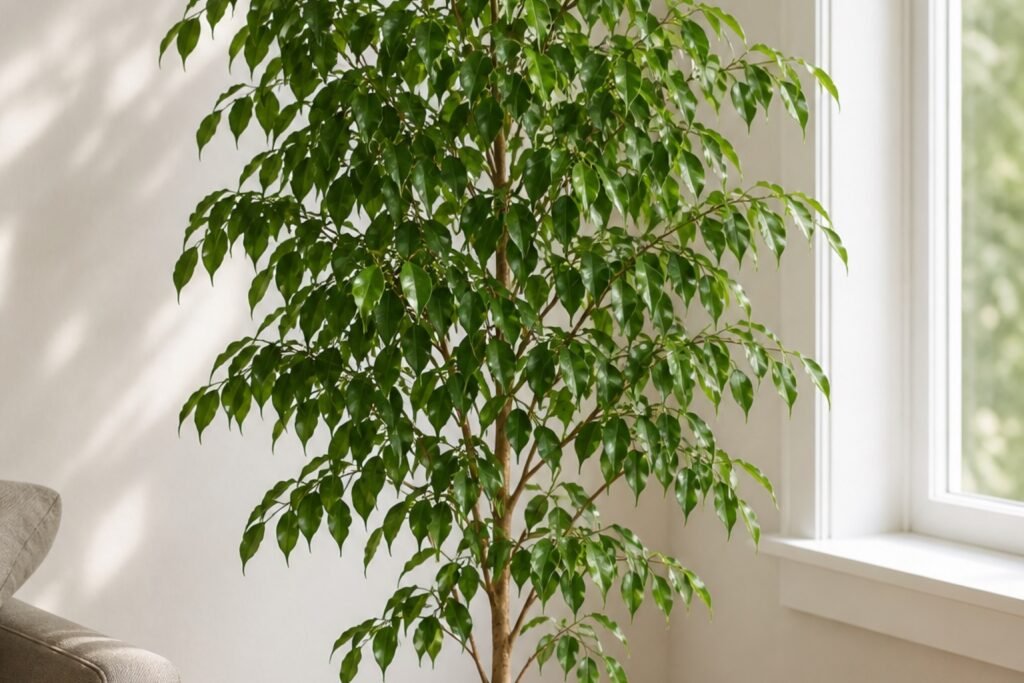
Weeping fig care indoors is less about a secret product than a stable place. Ficus benjamina notices a move from greenhouse to store, store to car, and car to a darker room. Green leaves may fall after each change. If the trunk is firm and the newest buds remain alive, another move is usually the wrong response.
Benjamin tree, Java fig, and small-leaved rubber plant are common names for this species. Do not confuse it with the rubber plant, Ficus elastica, or the fiddle leaf fig, Ficus lyrata. The weeping fig has many smaller elliptic leaves with long pointed tips on flexible drooping twigs.
Weeping fig care indoors snapshot
| Care point | Practical indoor target |
|---|---|
| Light | Bright indirect light from a steady position |
| Water | Water after the top 1 to 2 inches dry, before the root ball is dust dry |
| Soil | Structured soil-based mix with free drainage |
| Humidity | Moderate humidity with air movement |
| Temperature | Roughly 60 to 80 F, away from drafts |
| Mature indoor size | Commonly 2 to 10 feet tall |
| Growth rate | Moderate |
| Pet safety | Toxic to cats and dogs; latex irritates |
Choose one bright place and leave it there
Put the tree near an east window or in bright filtered light at a south or west exposure. The inner canopy should not disappear into a dark corner. A plant moved closer to direct sun needs gradual acclimation, especially if it spent weeks under retail lighting.
Weeping figs adjust their leaves to the light they receive. A sudden drop in light can trigger shedding even when no root problem exists. Use the grow-light decision guide if winter or a deep room cuts useful daylight. Once the site is corrected, resist carrying the pot around to chase every falling leaf.
Cold drafts cause another kind of shock. Keep the canopy away from an exterior door, air-conditioner, and heating vent. A few inches can matter when air blows directly across thin leaves.
Keep the center lightly moist, never swampy
Feel the top 1 to 2 inches and lift the pot. Water when the surface zone is dry and the pot is lighter, while the deeper root ball still holds a trace of moisture. Soak evenly and drain.
Letting the entire root ball become hard and dusty may trigger leaf drop. Keeping it constantly wet does the same through root injury. This is why the physical approach in how often to water indoor plants works better than a fixed interval.
If water shoots down a gap along the pot wall, the old mix may have shrunk. Rehydrate slowly or repot if the structure has failed. If yellow leaves fall while soil remains damp, check the roots before adding water. The guide to why houseplant leaves turn yellow helps separate old foliage from a spreading root problem.
Repot only when the root system gives a reason
A slightly snug weeping fig is easier to water than a small root ball lost inside a large floor pot. Repot when roots form a dense wall, water bypasses the center, or the mix no longer drains evenly. Move up one size and preserve healthy fine roots.
The full houseplant repotting process covers root inspection and aftercare. Expect some adjustment after repotting, but do not combine it with a move to a darker room and heavy pruning.
Feed lightly after active shoots begin. Pause when the plant is dropping leaves or roots are damaged. Fertilizer cannot compensate for low light, cold air, or saturated soil.
Prune for structure, not panic
Shorten a long branch just above a node with a clean blade. Wear gloves because cut stems release milky latex. Pruning during active growth gives replacement shoots a useful light window.
Stem tips root in warm, humid conditions. Air layering is practical for a thicker branch and produces a larger start. Both methods need a node or woody stem section; a detached leaf cannot grow a tree.
Clean dense foliage so scale and mites are easier to see. The guide to cleaning houseplant leaves avoids oily polishes that collect dust.
Weeping fig problem triage
| Symptom | Likely checks | First sensible move |
|---|---|---|
| Sudden green leaf drop | Move, lower light, draft, or moisture shock | List recent changes and stabilize the plant |
| Yellow leaves over damp mix | Poor aeration or damaged roots | Check the middle and bottom of the pot |
| Crisp brown margins | Dry roots, heat, or dry air | Compare pot weight and window temperature |
| Sticky leaves and brown bumps | Scale insects | Inspect twigs and leaf undersides |
| Fine pale speckling | Spider mites | Check the inner canopy for webbing |
Scale can make the leaves sticky with honeydew. Spider mites cause fine pale stippling and light webbing. Both hide inside a dense canopy. Isolate the tree and confirm which pest is present; the spider mite guide is a useful starting point when the damage is speckled rather than sticky.
A bare branch is not necessarily dead. Scratch a tiny patch of bark. Green tissue beneath can still produce buds, while a dry brittle twig that snaps cleanly may be removed.
Handle Ficus latex carefully
ASPCA lists Ficus benjamina as toxic to cats and dogs. Its latex contains irritating compounds and can cause digestive or skin signs. Keep fallen leaves away from pets and contact a veterinarian after a suspected ingestion.
People who react to latex or plant sap should wear gloves and avoid touching the face while pruning. Wash skin and tools afterward. Weeping fig does not belong among plants selected specifically for a pet-safe indoor collection.
Frequently asked questions
Will a weeping fig grow its leaves back?
It can regrow from live branches after conditions stabilize. Check for green tissue beneath the bark, provide bright filtered light, and avoid another abrupt move. Dead brittle twigs will not recover.
Why did my weeping fig lose leaves after I bought it?
The trip changed light, temperature, humidity, and often root moisture. Give it one suitable bright position and a consistent physical watering check. Some adjustment loss may continue before new buds appear.
Can I move a weeping fig outside for summer?
Yes, after nights are warm, but acclimate it to outdoor light and wind gradually. Reverse the process before bringing it inside. Every abrupt transfer can trigger another round of leaf drop.