
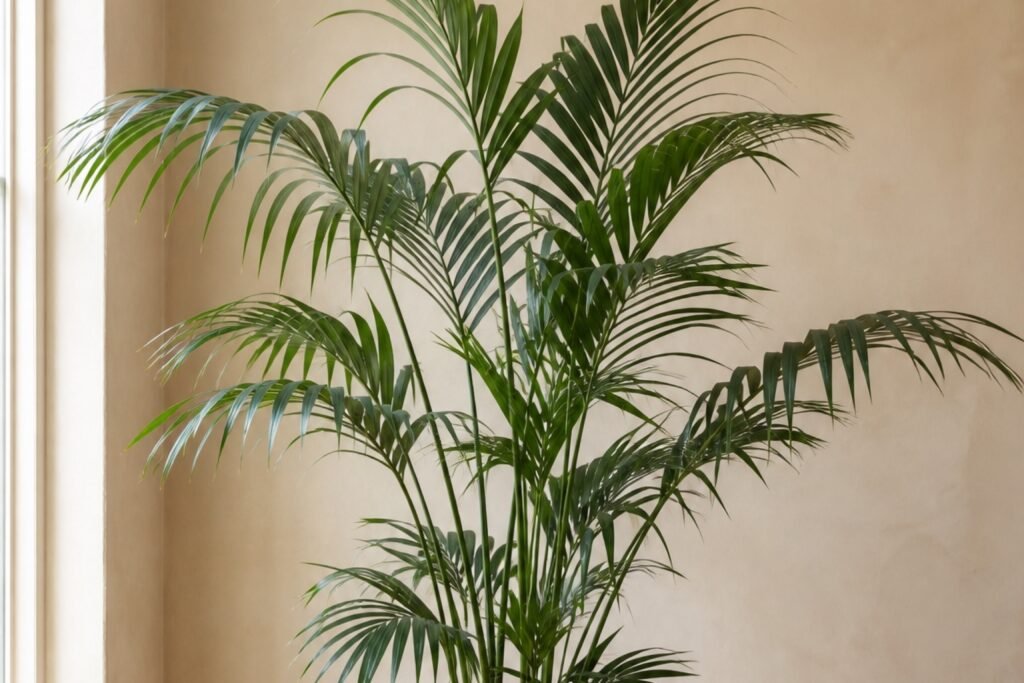
Kentia palm care indoors is slower and steadier than care for many tropical palms. Howea forsteriana grows from a single trunk and makes long, gently arching feather-shaped fronds. Nursery pots often contain several seedlings, which gives the plant a fuller silhouette. That cluster is not one palm producing suckers.
The species comes from Lord Howe Island, Australia. It tolerates ordinary indoor conditions better than many palms, but tolerance isn't the same as preference. Good filtered light and careful watering keep the oldest fronds from becoming a collection of brown tips.
Kentia palm care indoors at a glance
| Care point | Practical indoor target |
|---|---|
| Light | Medium to bright indirect light, away from harsh sun through glass |
| Water | Water when the upper 2 inches dry and the pot becomes somewhat lighter |
| Soil | Humus-rich, well-drained palm or houseplant mix |
| Humidity | Average to moderate room humidity |
| Temperature | About 60 to 85 F |
| Mature indoor size | Commonly 6 to 10 feet tall, with a narrower spread |
| Growth rate | Slow |
| Pet safety | ASPCA lists Howea forsteriana as non-toxic to cats and dogs |
Kentia palm care indoors begins with usable light
Kentia palms are famous for handling lower light, which sometimes lands them in places too dark for healthy growth. A bright room with no hot direct sun is a better target. Several feet from a south or west window may work, while an east-facing position often needs less buffering.
Growth is slow even under good conditions. In weak light it can nearly stop, and wet soil then takes much longer to dry. Watch the direction of new fronds rather than rotating the pot every few days. A gentle quarter turn once in a while is enough. If the room stays dim for months, the grow light guide helps compare the window with a simple supplement.
Do not move a shade-grown palm straight into direct summer sun. Abrupt exposure can bleach or scorch broad areas of the leaflets.
Let the upper layer dry, then soak the root ball
Feel about 2 inches into the mix and lift or tilt the pot. Water when that upper layer is dry and the container is noticeably lighter, before the entire root ball turns bone dry. Pour slowly enough to wet the center, let water drain, and empty the saucer.
A large decorative pot can hide a wet nursery pot for days. Pull the inner pot out when checking, especially in winter. Low light and cool rooms reduce water use, so the same calendar interval will not fit every season. The physical checks in how often to water indoor plants are more reliable.
Brown tips do not automatically mean thirst. Severe dryness can cause them, but salts, damaged roots, low humidity, and nutrient trouble can look similar. If the pot is still wet, wait. Yellowing that moves across several fronds on wet soil deserves a drainage and root check.
Give the roots room, not an oversized pot
Use a draining, organic potting mix that stays open after repeated watering. A heavy mix can remain saturated around the center of a large root ball. A very coarse mix may dry too quickly around fine roots. The potting soil comparison explains how common ingredients change air space and moisture.
Kentia palms dislike needless root disturbance. Repot when roots have densely filled the container, drainage has become uneven, or the plant is no longer stable. Move up only a little and keep the old soil level against the trunk. The repotting guide shows how to choose a proportional pot without guessing from frond size.
Feed infrequently during active growth, following a product labeled for indoor plants or palms. More fertilizer won't make a slow species hurry. Salt buildup and nutrient imbalance can damage leaflet tips, so do not combine a strong dose with dry soil.
Propagation is by seed and is slow. Separating the multiple stems in a nursery pot means separating individual seedlings, not removing pups from one plant. That job can cause substantial root damage and is rarely necessary.
Humidity, cleaning, and pest checks
Average household humidity is usually workable if the plant is not beside a heater or air conditioner. A humidifier may help in a very dry winter room, but good watering and an undisturbed root zone matter first. The humidity guide separates room-scale changes from short-lived tricks.
Dust gathers along the many leaflets. Support the frond while wiping gently with a damp cloth; dragging a heavy frond can crease the central stalk. The method in how to clean houseplant leaves keeps oils and leaf-shine residue out of the routine.
Inspect the midrib, leaflet bases, and emerging spear for scale, mealybugs, and spider mites. A slow-growing palm cannot replace damaged foliage quickly, so early detection matters more than aggressive treatment after a large infestation.
Common Kentia palm problems
| Symptom | Likely checks | First sensible move |
|---|---|---|
| Brown leaflet tips | Dryness, salts, root stress, or nutrient imbalance | Check root moisture and recent feeding before trimming |
| Several yellowing fronds | Persistently wet mix, weak light, or root damage | Test the center of the pot and inspect drainage |
| Pale or bleached patches | Abrupt direct sun | Move out of the hot beam and acclimate slowly |
| Sticky bumps or residue | Scale insects | Isolate and inspect both sides of the leaflets |
| Fine stippling and dull color | Spider mites | Check with side light and magnification |
One lower frond aging is normal. A pattern across new and old growth is not. Use the houseplant problem diagnostic to compare moisture, light, and pest clues before removing multiple leaves.
Pet and household safety
The ASPCA record names Howea forsteriana and lists it as non-toxic to cats and dogs. That exact botanical match is useful because common names such as paradise palm and thatch palm can refer to other plants.
Non-toxic does not mean edible. Chewed leaflets and potting mix can still upset an animal's stomach or create a choking risk. Keep the pot stable and contact a veterinarian if a pet develops symptoms after chewing any plant.
Frequently asked questions
Can a Kentia palm live in low light?
It tolerates lower light better than many palms, but growth slows and wet soil lingers. Medium filtered light gives a healthier balance. If no clear shadow forms near the plant during the day, the location may be too dim.
Why are the tips of my Kentia palm turning brown?
Check the root zone first. Dryness, salt buildup, wet damaged roots, and nutrient imbalance can all brown tips. Trim only dead tissue, then judge whether new fronds stay clean.
Should I separate the trunks in a Kentia palm pot?
Usually not. Those trunks are often separate seedlings planted together for fullness. Pulling them apart can tear a mature root mass, and the slow-growing palms may take a long time to recover.