
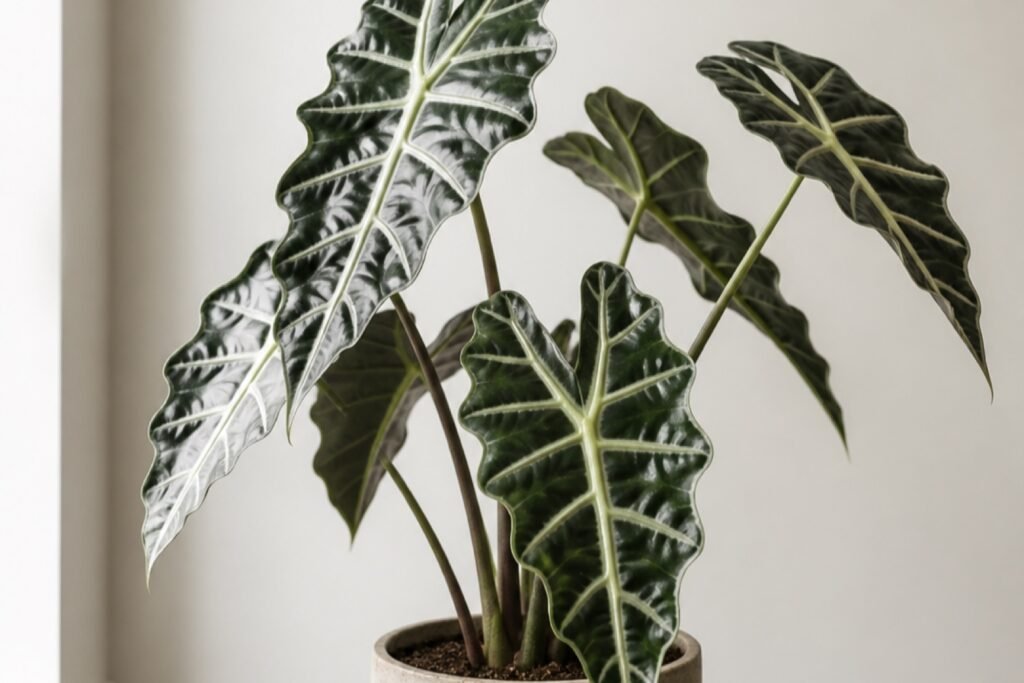
Alocasia Polly care gets complicated when the label starts the plant under the wrong name. The accepted hybrid is Alocasia × mortfontanensis 'Polly'. Shops often use Alocasia × amazonica, African mask plant, or the spelling Poly. The compact plant has glossy arrow-shaped leaves, pale veins, and deeply wavy margins.
It wants bright filtered light, warmth, and a root zone that stays neither swampy nor bone dry. It may also pause or lose leaves during a cool, dim winter. A dormant corm is not automatically dead.
Alocasia Polly care at a glance
| Care point | Practical indoor target |
|---|---|
| Light | Bright indirect light; gentle morning sun after acclimation |
| Water | Water after the upper 1 to 2 inches dry, then drain fully |
| Soil | Airy moisture-holding aroid mix in a pot with drainage |
| Humidity | High humidity with good air movement |
| Temperature | About 65 to 85 F |
| Mature indoor size | Commonly 18 to 36 inches tall and wide |
| Growth rate | Moderate in warm active growth, slow or paused in winter |
| Pet safety | ASPCA lists Alocasia species as toxic to cats and dogs |
Alocasia Polly care begins with warm bright light
Place it near an east window or a little back from stronger south or west glass. A sheer curtain protects the dark leaves from hot midday sun. Rotate the pot carefully because the petioles turn toward the strongest light.
Weak light produces long leaning petioles and a smaller leaf. Too much direct sun leaves bleached or dry tan patches. Adjust exposure over several days rather than carrying the plant from a dark store shelf into full sun. If natural light is marginal, use the measurements in do you need a grow light before adding a decorative lamp.
Cold matters as much as brightness. Keep the pot away from exterior doors, air-conditioning vents, and cold winter glass. Chilly wet soil is a difficult combination for the roots.
Water by depth and pot weight
Push a finger or wooden skewer 1 to 2 inches into the mix. When that layer is dry and the pot feels lighter, water until the full root ball is wet. Empty the saucer or cachepot. Do not let the pot stand in runoff.
The plant may droop on dry soil, but a wet plant with failing roots also droops. Check before watering. The cue-based method in how often to water indoor plants prevents a weekly schedule from overriding what the root zone is doing.
During a winter pause, the plant uses water more slowly. Let the surface dry a little farther and keep checking the corm and roots. Do not compensate for leaf loss with extra fertilizer.
Build an airy root zone
Use a pot only slightly wider than the roots and corms. A loose mix should hold some moisture while allowing air back in after watering. Dense garden soil and a pot without drainage leave the center wet too long. The potting soil comparison explains the texture signals to check.
Repot when roots crowd the pot, corms push against the sides, or old mix collapses. Keep the main corm at its previous level, remove only dead soft roots, and avoid a dramatic size jump. Our repotting guide covers a measured move.
Small offset corms can be separated when they have roots of their own. A hard dormant corm can resprout in warmth and useful light. A soft, foul-smelling corm should be discarded.
Give humidity without wetting every leaf
A room humidifier can reduce crisp edges when heating or air conditioning dries the air. Keep enough space around the foliage for it to dry after cleaning. Misting is brief and can leave mineral marks on dark leaves. The practical options in how to increase humidity for houseplants are easier to measure.
Feed lightly while new leaves are opening. Follow the product label and pause during dormancy, after repotting, or while roots are damaged. Wipe leaves with plain water so mite stippling remains visible.
Common Alocasia Polly problems
| Symptom | Likely checks | First sensible move |
|---|---|---|
| Yellow soft leaf | Wet mix, weak light, or an aging oldest leaf | Check deep moisture and whether loss is spreading |
| Drooping petioles | Dry roots, damaged wet roots, cold, or weak light | Check soil, roots, and temperature before watering |
| Brown crisp edges | Dry air, salt buildup, or uneven moisture | Stabilize humidity and flush the mix if drainage is sound |
| Fine pale speckling | Spider mites | Isolate and inspect the leaf backs with magnification |
| All leaves disappear | Seasonal dormancy or serious corm decline | Keep a firm corm warm and only lightly moist; discard a soft one |
Spider mites favor the sheltered backs of the large leaves. The spider mite guide covers repeated treatment, egg cycles, and nearby plant checks. One old yellow leaf is normal. Several leaves failing while the pot remains wet need a root inspection.
Pet and household safety
The ASPCA Alocasia entry is genus-level rather than a specific test of the Polly hybrid. It lists insoluble calcium oxalates and classifies Alocasia as toxic to cats and dogs. Chewing may cause oral pain, drooling, vomiting, and trouble swallowing. Sap can irritate people as well. Keep the plant and separated corms away from pets and children, wear gloves when dividing, and seek prompt veterinary help if symptoms follow exposure. Our pet-safe plant guide explains the limits of genus-level records.
Frequently asked questions
Is Alocasia Polly the same as Alocasia amazonica?
The names refer to the same cultivated hybrid in trade, but Kew accepts Alocasia × mortfontanensis. The name A. × amazonica remains a common synonym.
Why did my Alocasia Polly lose all its leaves?
Cool, dim conditions can trigger dormancy, while wet roots can destroy the corm. A firm corm may regrow when warmth and light return. A soft or foul-smelling corm is unlikely to recover.
Should I cut off a yellow Alocasia leaf?
Wait until it is mostly yellow, then cut the petiole near the base with clean shears. Check the root zone if more than the oldest leaf is failing.