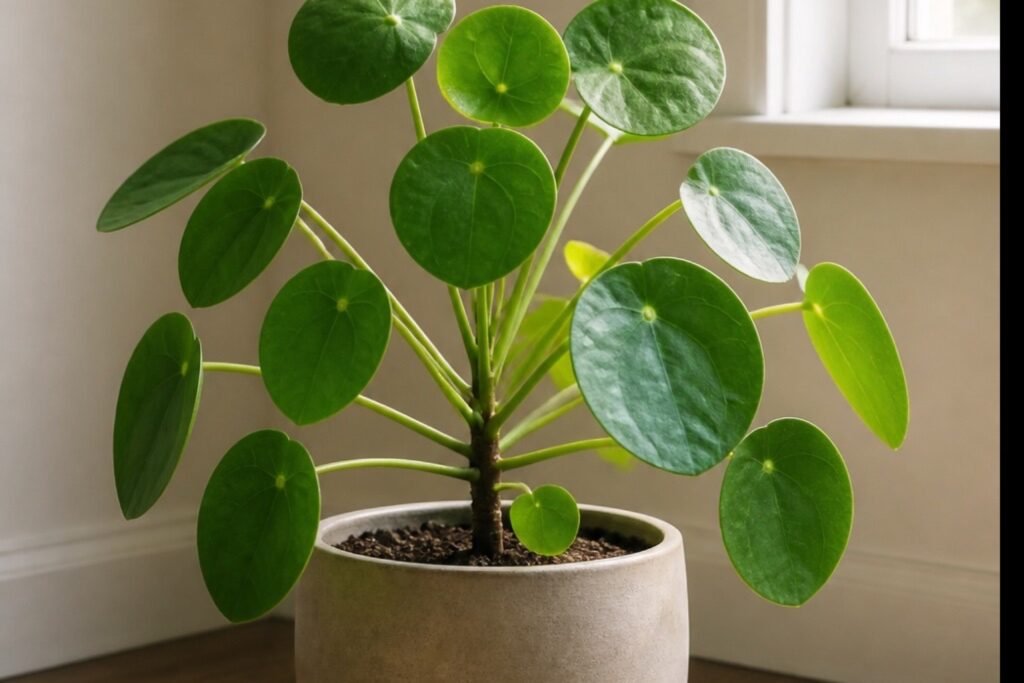
Chinese money plant care is less mysterious than the plant's round leaves make it look. Pilea peperomioides wants generous filtered light, a pot that drains, and a short drying spell between drinks. The awkward part is balance. Too little light stretches the stem, while too much hot sun marks the leaves. Constantly damp soil causes a different set of problems.
The plant comes from cool, shaded mountain areas in Yunnan, China. It grows as a compact upright plant with coin-shaped leaves held on long petioles. Healthy plants often make offsets, or pups, around the base. Those pups explain the familiar nickname friendship plant, though that name is also used for other Pilea species.
Chinese money plant care snapshot
| Care point | Practical indoor target |
|---|---|
| Light | Bright indirect light with gentle early sun if acclimated |
| Water | Let the upper inch or two dry, then soak and drain |
| Soil | Loose houseplant mix with added coarse drainage material |
| Humidity | Average to moderate household humidity |
| Temperature | Roughly 60 to 75 F, away from cold drafts |
| Mature indoor size | Usually about 8 to 12 inches tall and wide |
| Growth rate | Moderate in good light |
| Pet safety | No species-specific veterinary listing was confirmed for this profile |
Give the stem light from more than one side
Place the plant close to a bright window where direct midday or afternoon sun is filtered. A little mild morning sun is usually easier to manage, but introduce it gradually. Sudden exposure can leave pale tan patches that never turn green again.
The stem bends toward a window quickly. Rotate the pot a quarter turn every week or two if you want a balanced crown. Rotation cannot replace light, though. Long petioles, wide gaps between leaves, and a plant that leans again within days point to a dim location. Our guide to leggy indoor plants explains how to improve the location without shocking the foliage.
If the room has no useful window, a small lamp can work. Start with the basics in do indoor plants need a grow light rather than guessing from how bright the room feels to your eyes.
Water the root ball, not the calendar
Push a finger into the upper inch or two and lift the pot. When that layer is dry and the container feels lighter, water the whole root ball. Let excess run out, then empty the saucer. A quick splash wets only part of the mix and can leave dry pockets around the fine roots.
Lower leaves sometimes droop a little when the plant is ready for water. Treat that as supporting evidence, not the only test. Drooping also follows root damage, cold, and an abrupt change in light. The method in how often to water indoor plants combines soil feel, pot weight, and the plant's recent environment.
Several yellow leaves on wet soil call for restraint. Check drainage and roots before watering again. One old lower leaf turning yellow while fresh leaves keep opening is much less alarming.
Use a modest pot with an open mix
Choose a container with a drainage hole. A regular indoor mix amended with coarse perlite, fine bark, or another stable porous material is usually enough. The goal is an evenly wet root ball that also releases excess water. Heavy garden soil is a poor fit for a small indoor pot.
Move up only one pot size when roots fill the container, water stops entering evenly, or the plant becomes unstable. A large jump leaves a ring of unused wet soil around the original root ball. Keep the stem at its old depth and follow the practical steps in our houseplant repotting guide.
Feed lightly while new leaves are opening. A complete houseplant fertilizer used as its label directs is plenty. Pale growth caused by low light does not become stronger with extra fertilizer, and salt buildup can damage leaf edges.
Separate pups after they have roots
Pups may rise from the soil beside the parent or appear close to the stem. Wait until a pup has several leaves and some roots of its own. Gently expose the connection, cut with a clean blade, and pot the offset in a small container. A tiny pup with no roots loses moisture quickly and is harder to establish.
You can also leave the pups in place for a fuller clump. There is no rule that every offset must become a separate plant. Iowa State's guide to propagation by division and offsets supports the same patient approach: separate a useful rooted section, not the smallest growth you can find.
Common Chinese money plant problems
| Symptom | Likely checks | First sensible move |
|---|---|---|
| Long petioles and a leaning stem | Light too low or one-sided | Move closer to filtered light and rotate gradually |
| Several yellow lower leaves | Wet mix, poor drainage, or root stress | Check moisture and roots before watering |
| Curled or cupped leaves | Heat, light shift, moisture stress, or normal variation | Review the recent location and watering history |
| Pale tan spots | Direct sun or cold contact | Move away from harsh sun or cold glass |
| Fine speckling or webbing | Spider mites | Isolate and inspect leaf undersides |
Round leaves make small changes obvious, but leaf shape alone rarely proves one cause. Compare the whole pattern. If the tips are dry, the brown leaf tip guide helps separate dry air, salts, uneven watering, and root trouble.
Wipe dusty leaves with a damp cloth while supporting each petiole. This is also a good time to look for mites, scale, or mealybugs. Skip oily leaf shine.
Pet safety needs an exact name
No species-specific ASPCA page for Pilea peperomioides was confirmed during this review, so this profile does not label it verified pet safe. That is different from saying it is toxic. Keep the nursery label, discourage chewing, and ask a veterinarian about a known ingestion. The pet safe indoor plant guide explains why common names and close relatives are not enough for a safety decision.
Frequently asked questions
Why is my Chinese money plant leaning?
It is probably growing toward the strongest light. Move it closer to bright filtered light and rotate the pot gradually. A weak stem with long gaps between leaves points to insufficient light rather than a need for more water.
Should I remove every pup from the parent plant?
No. Leave them for a fuller pot or separate only pups that have several leaves and their own roots. Very small offsets are more vulnerable to drying and handling damage.
Why are the lower leaves turning yellow?
One old leaf can be normal. Several yellow leaves, especially above damp soil, suggest that water use and drainage need attention. Check the root zone before changing fertilizer or pot size.