White Mold on Houseplant Soil: What It Is and 5 Safe Fixes
Last updated: July 23, 2026.
White mold on houseplant soil is a useful description, but it is not a diagnosis. The white material might be a surface fungus feeding on organic matter in the potting mix. It might be mineral or fertilizer salts. If it is spreading onto the stem, crown, roots, or leaves, it may be a plant disease that needs a different response.
Start here: For a complete overview, see our Indoor Gardening for Absolute Beginners.
Start with texture and location. A loose, fuzzy mat on otherwise normal potting mix is usually a surface growth problem. A hard, chalky crust points toward salts. White growth attached to soft, discolored, wilting, or dying plant tissue is the red flag.
Quick answer: do not reach for cinnamon or a fungicide first. Photograph the growth, inspect the plant, remove affected surface material if the plant is healthy, then correct the moisture or salt problem that allowed it to appear. Isolate the plant and seek a firm diagnosis when living tissue is involved.
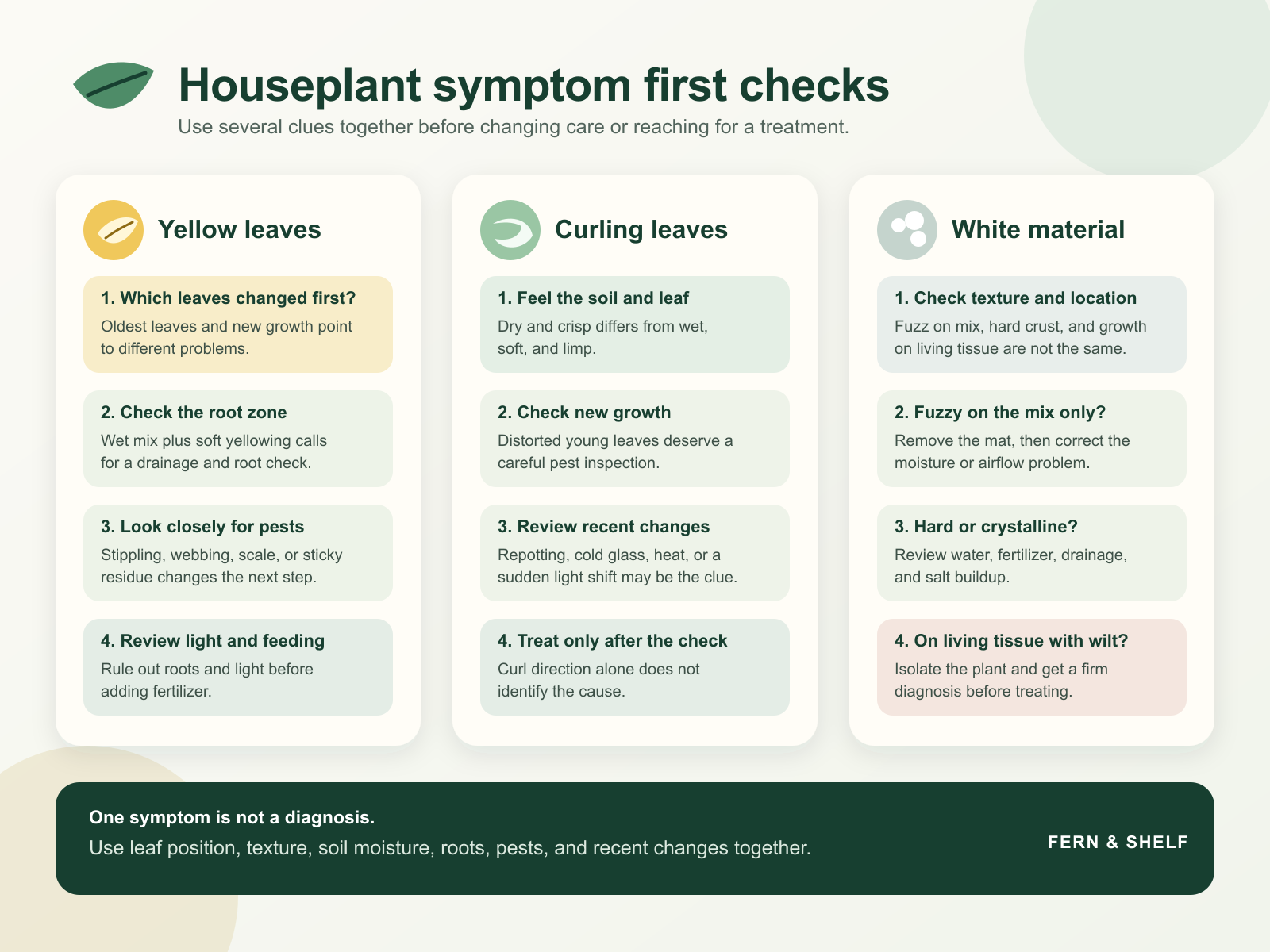
White mold on houseplant soil: a visual differential
Look closely before you scrape anything. Color alone is not enough.
| What you see | Most likely explanation | What to check next |
|---|---|---|
| White to gray fuzz, fine threads, or a thin mat sitting on the media | Surface fungal growth on damp organic potting material | Check how long the surface stays wet, whether dead leaves are present, and whether the pot drains freely |
| Hard, chalky, or crystalline white crust on the soil, pot rim, or drainage hole | Mineral or fertilizer salt buildup | Review water source, fertilizer rate, drainage, and whether the plant sits in runoff |
| Firm white particles mixed throughout the potting mix | Perlite or another normal media component | Pick up one piece. Perlite is hard and does not spread into threads |
| White growth on a stem or crown, plus wilt, lesions, collapse, or soft roots | Possible crown, stem, or root disease | Isolate the plant and inspect the affected tissue and roots before treating |
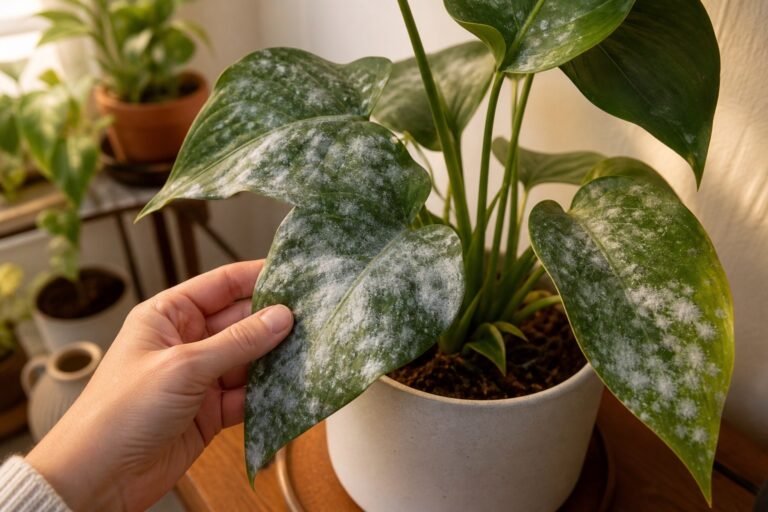
| Powdery patches on leaves or green stems | Possible powdery mildew or another foliar problem | Keep it separate from a soil-surface diagnosis and confirm the disease |
The first two rows cause most of the confusion. University of Maryland Extension describes surface fungi as white to gray growth on moist growing media that is usually not detrimental to the plant. The same extension service describes mineral deposits as a crystallized coating or crust. One is biological growth. The other is residue left behind as water evaporates.
If it is surface fungal growth
Potting mixes contain bark, peat, coir, composted material, and other organic ingredients. Fungi can use that material as food when the surface stays damp. The growth is often more about the potting environment than the plant itself.
A small patch on the media does not prove that the roots are infected. Still, it is worth correcting. A dense mat can interfere with water entering the mix, and damp organic media can support fungus gnats. Wet media also makes root problems more likely, so check the plant instead of treating the surface in isolation.
Why it keeps appearing
- The surface stays wet for too long. This may come from frequent watering, a large pot, a dense mix, cool conditions, or a blocked drainage hole.
- Air movement is limited. Crowded leaves and tightly grouped pots slow evaporation around the media.
- Dead organic material is available. Fallen leaves, old flowers, and decomposing top dressing give surface fungi more material to colonize.
- The plant is using water slowly. A low-light placement does not create fungus by itself. It can keep the pot wet longer because the plant grows and transpires more slowly.
A watering calendar cannot account for those differences. Use the plant, pot, and moisture in the root zone to decide when to water. The guide to watering indoor plants explains why one fixed weekly schedule fails.
Five safe steps for surface growth
1. Photograph it and inspect the whole plant
Take a clear photo before disturbing the surface. Check both sides of the leaves, the stem at soil level, and the drainage holes. Note whether the plant is upright and growing, or whether it is wilting, yellowing, dropping leaves, or developing soft tissue.
This first look prevents a common mistake: removing the visible patch while missing a crown or root problem underneath.
2. Remove the mat and dead debris
If the growth is confined to the media and the plant looks healthy, lift away the fungal mat and the thin layer of mix directly under it. Bag the material and clear fallen leaves or flowers from the pot. Work gently so you do not scatter dry material around the room.
3. Check drainage before the next watering
Make sure the container has an open drainage hole and that no water is trapped inside a saucer or decorative cachepot. Probe below the surface. If the root zone is still moist, wait. When the plant does need water, soak the mix evenly and let the excess drain away.
If water sits on top, runs down a gap at the pot edge, or takes a long time to drain, use the potting soil drainage checklist. Adding more water will not repair compacted media.
4. Give the pot room to dry normally
Space the plant so air can move around the pot. Move it to the amount of light recommended for that species, but do not put a shade plant into harsh direct sun as a mold treatment. A room fan can help in a crowded collection, though it should not blast one plant all day.
Do not cover the surface with a decorative layer just to hide the problem. Fine sand or tightly packed gravel can make it harder to judge moisture, and a top dressing does not fix a pot that stays wet deep down.
5. Repot only when the evidence calls for it
Repot if the growth returns as a thick mat, the media has collapsed, drainage remains poor, or the plant shows root symptoms. Slide the root ball out and look for firm roots appropriate to the species. Dark, soft, limp, or easily broken roots point toward a bigger problem.
Use a clean container and fresh mix suited to the plant. The houseplant repotting guide covers the process, while the indoor potting mix guide helps with the media choice. Do not move a small root ball into a huge pot. The extra wet mix can make drying slower.
If it is a mineral or fertilizer crust
A salt crust does not behave like fuzz. It feels hard or gritty and often shows up on the pot rim or around the drainage hole too. Hard water and repeated fertilizer applications can both leave salts behind.
Salts are not just ugly. A heavy buildup can make it harder for roots to take up water and may contribute to tip burn, weak growth, or wilting even when the mix is moist.
- Remove the loose crust and a small amount of affected surface mix without damaging shallow roots.
- Pause fertilizer until the plant is growing normally and the buildup has been addressed.
- If the pot drains freely, flush from the top with clear water and let every pass drain completely. Empty the saucer.
- Use water lower in dissolved minerals when practical.
- Repot in severe cases, especially when crusting returns quickly or roots show injury.
University of Maryland Extension recommends top watering and leaching for mineral buildup rather than relying on bottom watering. That matters here because a method that keeps the surface looking dry can still leave salts in the root zone.
Red flags that point beyond harmless surface growth
Stop treating this as a cosmetic soil problem if any of the following are present:
- White growth is attached to the stem, crown, roots, leaves, or flowers.
- One stem wilts suddenly or develops a tan, brittle, water-soaked, or collapsing section.
- Roots are dark, soft, limp, or easy to pull apart.
- The plant has spreading leaf spots, powdery colonies, mosaic patterns, or rapid dieback.
- Small hard structures appear in or on infected tissue. Black, irregular structures within white growth are especially useful diagnostic evidence.
- The problem spreads to nearby plants.
The disease called white mold, caused by Sclerotinia sclerotiorum, is not the same thing as every pale fungus on potting mix. University of Minnesota Extension describes true white mold disease with wilted stems, infected stem tissue, fluffy growth on living tissue, and hard black sclerotia. A photo of the soil surface cannot confirm it.
Isolate a plant with living-tissue symptoms. Keep the original photos, avoid sharing tools between plants, and contact a university Extension office or plant diagnostic lab. A good sample includes the whole plant pattern, affected tissue, roots, potting history, and recent care changes.
Why this guide does not recommend cinnamon
The old version of this article suggested dusting the soil with ground cinnamon. That advice has been removed. Kitchen cinnamon has no standardized rate for this problem, and a dusting does not tell you whether the material is fungus, salts, or disease. It also leaves the moisture and drainage conditions untouched.
The same caution applies to a random fungicide. Plant diseases are easy to misdiagnose, and many fungicides are preventive rather than curative. Use one only when the disease and plant are listed on the label and the diagnosis supports it. A surface fungus on potting media usually responds to removal, normal drying, and better air movement.
What about people and pets?
You cannot identify a fungus or its health significance from color alone. Do not let children or pets eat potting material or fungal growth. Avoid sniffing it or brushing a dry mat into the air. Wash your hands after cleanup. If mold exposure is a personal health concern, ask a qualified medical professional rather than relying on a plant identification article.
Frequently asked questions
Does white growth on soil mean root rot?
No. Surface growth alone does not diagnose root rot. Both can occur in a pot that stays wet, so check the plant and roots when there is persistent wilt, yellowing, odor, collapse, or poor drainage. If the plant is declining, use the overwatered plant and root check.
Can I just scrape it off?
For a small surface patch on a healthy plant, yes, but scraping is only the first step. If the media remains wet for days, the growth will probably return.
Is the white material just perlite?
Perlite appears as firm, irregular white pieces throughout the mix. It does not form threads, spread across debris, or turn into a soft mat. A hand lens makes the difference easier to see.
Should I replace all the potting mix?
Not for one small patch on an otherwise healthy plant. Repot when the mat is heavy or recurrent, drainage is poor, the mix has broken down, salts are severe, or roots are unhealthy. Unnecessary repotting adds another stress.
Will more light cure it?
Light is not a stand-alone treatment. Correct light helps the plant use water at a normal rate, but a clogged pot, dense media, or frequent watering can keep the root zone wet in a bright room too.
The short version
Fuzzy growth on the media, a crystalline salt crust, and disease on living tissue can all look white. Treating them as one problem leads to bad fixes. Identify the texture and location, check the plant, correct moisture or salts, and escalate when stems, crowns, roots, or leaves are involved.
Sources and further reading
- University of Maryland Extension: Algae and Fungal Growth on the Soil of Indoor Plants
- University of Maryland Extension: Mineral and Fertilizer Salt Deposits on Indoor Plants
- Iowa State University Extension: Diagnosing Houseplant Problems from Diseases
- University of Minnesota Extension: White Mold in the Garden
- National Pesticide Information Center: Fungicides