
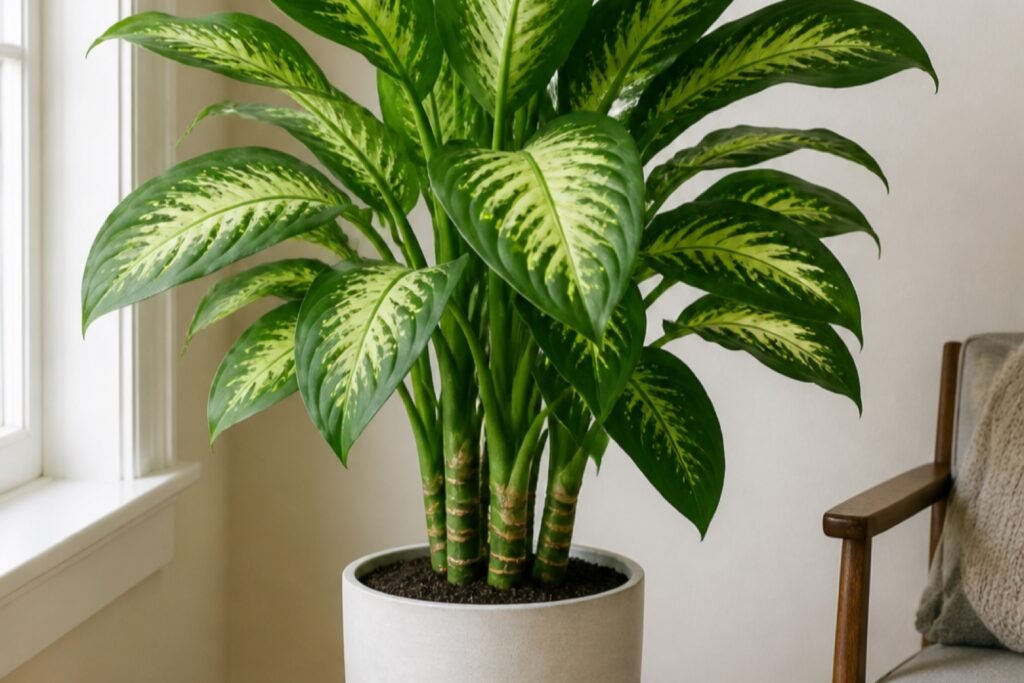
Dieffenbachia care indoors is mostly a matter of avoiding two extremes: a dim corner that stretches the canes and a wet pot that slowly weakens the roots. This profile covers Dieffenbachia seguine and the common houseplant cultivar group sold under that name. Their broad leaves may be cream, lime, and deep green, but the underlying care stays much the same.
The older common name dumb cane refers to the oral irritation caused by the plant. It is better treated as a safety warning than as a useful plant name.
Dieffenbachia care indoors at a glance
| Care point | Practical indoor target |
|---|---|
| Light | Medium to bright indirect light; variegated forms need the brighter end |
| Water | Water when the upper inch dries, then drain the pot fully |
| Soil | Loose, moisture-holding indoor mix with reliable drainage |
| Humidity | Moderate humidity with air movement |
| Temperature | About 65 to 80 F; keep away from cold drafts |
| Mature indoor size | Often 3 to 6 feet, depending on cultivar and pruning |
| Growth rate | Moderate to fast in warm, bright conditions |
| Pet safety | Toxic to cats and dogs; sap can irritate people |
Put the leaf pattern in useful filtered light
An east window or a position near a bright north window suits many plants. A sheer curtain can soften stronger south or west exposure. Pale cultivars may scorch if moved abruptly into direct sun, while plants several feet into a dark room often produce smaller leaves and long bare gaps between them.
Watch the newest growth. A mature leaf cannot repair a bleached patch, and an old stretched cane will not become shorter. Better conditions show up in the next leaf. If natural light is hard to judge, the placement tests in do you need a grow light are more useful than calling the room bright by eye.
Turn the pot occasionally so one side does not carry the whole canopy. Clean broad leaves with a damp cloth while supporting them from below. Our leaf-cleaning guide avoids oils that can smear the variegation and hide pests.
Water after a real surface dry-down
Feel the upper inch of mix and lift the pot if possible. When the surface is dry and the container is lighter, water slowly until the full root ball is wet. Let the excess escape. A little water poured into the same spot every few days leaves some roots dry and others constantly damp.
One drooping afternoon is not a schedule. Dieffenbachia leaves may hang after a dry spell, but damaged roots can create a similar look. Check the root zone before watering. The physical cues in how often to water indoor plants help when room temperature, light, and pot size keep changing.
Cold water is less important than cold air. A plant pressed against winter glass or placed beneath an air conditioner may develop yellow patches and sudden leaf loss even when the soil is reasonable.
Use a modest pot and an airy mix
Choose a container with a drainage hole, only slightly wider than the root ball. A mix that holds some moisture but still springs apart after squeezing is a better fit than dense garden soil. The potting soil comparison explains what to look for without demanding one exact recipe.
Repot when roots form a tight mat, the mix collapses, or water stops moving evenly through the pot. Keep the cane at its old depth. Burying a bare lower stem can hold wet material against tissue that was not growing underground. Wear gloves, keep sap away from the face, and wash tools after the job. The repotting guide covers root checks and pot sizing.
Renew a bare cane instead of hiding it
Older Dieffenbachia naturally shed some lower leaves. If the plant has become top-heavy, a healthy cane can be cut back during active growth. Nodes below the cut may produce new shoots. Sections of sound cane can also root horizontally or vertically in a clean, lightly moist medium. Mark which end was up before cutting several similar pieces.
Do not propagate a soft, discolored cane. Rot travels through weakened tissue, and a cutting cannot rescue a section that is already breaking down. Clean pruners and a firm node matter more than rooting products.
Feed lightly while the plant is opening new leaves, following the fertilizer label. Pause after repotting or during a winter slowdown. Extra fertilizer in a dark room often leaves salts in the soil without creating stronger growth.
Common Dieffenbachia problems
| Symptom | Likely checks | First sensible move |
|---|---|---|
| Yellow lower leaves | Wet soil, cold exposure, or normal aging | Check moisture and temperature before removing the leaf |
| Brown leaf edges | Dry air, salt buildup, or irregular watering | Flush the mix and stabilize root moisture |
| Long bare cane | Weak light or natural aging | Improve light, then consider a clean cut above a node |
| Fine pale stippling | Spider mites | Inspect leaf undersides with magnification |
| White cottony clusters | Mealybugs | Isolate the plant and check petioles and cane joints |
Mealybugs often settle where a broad petiole meets the cane. The treatment steps in how to get rid of mealybugs work only when repeat inspections include those tight joints. For widespread yellowing, use the yellow houseplant leaves guide before changing several parts of the routine together.
Pet and household safety
The ASPCA Dieffenbachia entry is genus-level and lists insoluble calcium oxalates plus a proteolytic enzyme. Chewing can cause intense oral irritation, drooling, vomiting, and trouble swallowing in cats and dogs. The sap can also irritate human skin and eyes. Keep the plant out of reach, wear gloves for major cuts, and clean fallen pieces promptly. Seek veterinary or medical help for significant exposure, swelling, or breathing trouble.
Frequently asked questions
Can Dieffenbachia grow in low light?
It may hold older leaves in lower light, but growth usually becomes thinner and variegation may weaken. Medium to bright indirect light produces a sturdier plant.
Why is my Dieffenbachia stem bare at the bottom?
Some lower-leaf loss is normal as the cane ages. Weak light, chronic root stress, and abrupt cold can speed it up. Fix the growing conditions before cutting the cane back.
Can I root a Dieffenbachia cane with no leaves?
Yes, a firm cane section with a viable node can root and sprout. Keep its orientation clear, use clean tools, and discard soft or discolored tissue.