
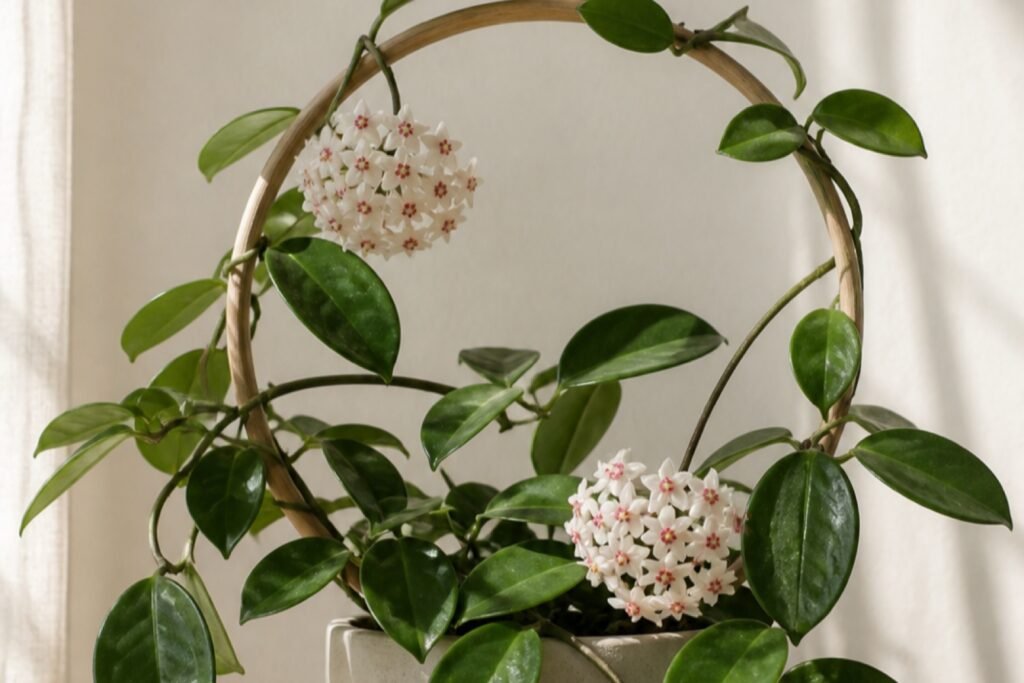
Hoya carnosa care is a slow negotiation with a plant that stores water in thick leaves and resents being fussed over. Hoya carnosa, the wax plant, grows long flexible vines with opposite oval leaves. Mature vines may produce rounded clusters of white star-shaped flowers with pink centers. Those flowers are possible indoors, but only after light, roots, and watering are working together.
This page covers Hoya carnosa. Heart-shaped single leaves belong to Hoya kerrii, and generic Hoya advice can blur meaningful differences between species.
Hoya carnosa care at a glance
| Care point | Practical indoor target |
|---|---|
| Light | Bright indirect light, with some gentle morning or late-day sun |
| Water | Let most of the potting mix dry, then soak and drain |
| Soil | Coarse, airy container mix in a small pot with drainage |
| Humidity | Average to moderate humidity with air movement |
| Temperature | About 60 to 85 F |
| Mature indoor size | Vines commonly reach 3 to 10 feet over time |
| Growth rate | Slow to moderate, often seasonal |
| Pet safety | ASPCA lists Hoya carnosa as non-toxic to cats and dogs |
Hoya carnosa care starts with brighter light
A wax plant can hold its leaves in middling light, yet flowering and sturdy new vines usually need a brighter position. An east window is often easy to manage. Near south or west glass, filter harsh midday sun or place the vine a little farther back. Increase direct exposure gradually because leaves raised in shade can scorch.
Long gaps between leaves and thin wandering vines point toward weak light. A short leafless runner is not automatically a problem, though. Hoyas often send out exploratory vines before new leaves expand. Do not cut every bare tip unless it is dry or clearly damaged.
If window light is limited, the measurements in do you need a grow light help distinguish a decorative lamp from useful plant light. A consistent bright site is more effective than moving the pot around every few days.
Let the pot become light before watering
Thick leaves reduce water loss, so a wax plant does not use moisture like a thin-leaved fern. Check deep into the pot and lift it. Water when most of the mix is dry and the container feels distinctly lighter, then soak the root ball and let it drain.
Wrinkled leaves can follow severe dryness, but they can also appear when damaged roots cannot take up water. If the mix is wet, more water is not the answer. The root and pot checks in how often to water indoor plants are safer than reading one leaf in isolation.
Avoid routine misting. It does little for room humidity and keeps flower clusters or crowded leaves wet. Stable room air, a clean canopy, and a sensible watering interval are enough in many homes.
Keep the root zone compact and airy
Choose a pot only slightly wider than the roots. Hoyas often flower while comfortably snug, but that does not mean they need to be trapped in collapsed soil. Repot when water races around a hard root mass, roots block the drainage hole, or the old mix stays wet and airless.
A coarse mix with reliable drainage suits the fine roots. The goal is air as well as water, not a pot that dries in a few hours. Our potting soil comparison explains the texture tradeoff, while the repotting guide shows how to size the next container without tearing apart every root.
Do not bury old vines or the base of the plant more deeply during repotting. Keep the crown at its previous level and attach long vines to a hoop or trellis without pulling them tight.
Preserve the flower spurs
Hoya flowers form from short persistent structures called peduncles. After a cluster fades, leave its little spur in place. The same peduncle can flower again. Remove only dry individual blossoms and any truly dead tissue.
Bright light, mature vines, and a stable routine matter more for bloom than a special fertilizer. Feed lightly during active growth with a complete product used as its label directs. Stop when growth pauses. A heavy dose can leave salts in a small root zone and still fail to produce flowers.
Vines can be propagated from stem cuttings with at least one node, though two nodes provide more options. Root in a clean airy medium or water, then move the cutting before a huge mass of delicate water roots develops. The clean-cut steps in propagating houseplants in water are useful even when another medium is chosen.
Common Hoya carnosa problems
| Symptom | Likely checks | First sensible move |
|---|---|---|
| Wrinkled leaves | Very dry mix or roots damaged by wet soil | Check roots and deep moisture before watering again |
| Yellow soft leaves | Saturated mix, weak light, or root decline | Let the mix breathe and inspect root condition |
| Long leafless vines | Exploratory growth or insufficient light | Check the tip and light before pruning |
| White cottony clusters | Mealybugs | Inspect nodes, petioles, and the back of the trellis |
| Buds dry and fall | Abrupt moisture, temperature, or location change | Stabilize conditions and leave the peduncle intact |
Mealybugs hide where paired leaves meet the stem. Isolate the plant and use the full inspection cycle in our mealybug guide rather than wiping only the visible insects. Avoid spraying open flowers with soap or oil.
Pet and household safety
The ASPCA Honey Plant record identifies Hoya carnosa and lists it as non-toxic to cats and dogs. That classification does not make the plant edible. Chewing any fibrous foliage can still upset an animal's stomach, and a trellis can become a tangle hazard. Keep the pot sensibly placed and call a veterinarian if a pet develops symptoms after eating plant material. The distinction between non-toxic and harmless is covered in our pet-safe indoor plant guide.
Frequently asked questions
Why is my Hoya carnosa not flowering?
The plant may be too young, too dim, recently disturbed, or still building vines. Give it bright light, keep the root zone healthy, and leave old flower peduncles intact.
Should I cut the long bare vine on my Hoya?
Not immediately. A firm green runner may produce leaves later. Cut it only if it stays unproductive in good light for a long time, disrupts the space, or has a dry dead tip.
Does Hoya carnosa like to be root-bound?
It tolerates a snug pot and does not need frequent size increases. Repot when the mix has failed or roots and water no longer move normally, not just to give the vine more soil.