How Much Electricity Do Grow Lights Use? 5 Cost Examples
Last updated: August 19, 2026.
Affiliate disclosure: As an Amazon Associate I earn from qualifying purchases. Links marked “paid link” may earn Fern & Shelf a commission at no extra cost to you. Read our full Affiliate Disclosure.
Start here: For a complete overview, see our Do You Need a Grow Light for Your Indoor Plants? An Honest Look.
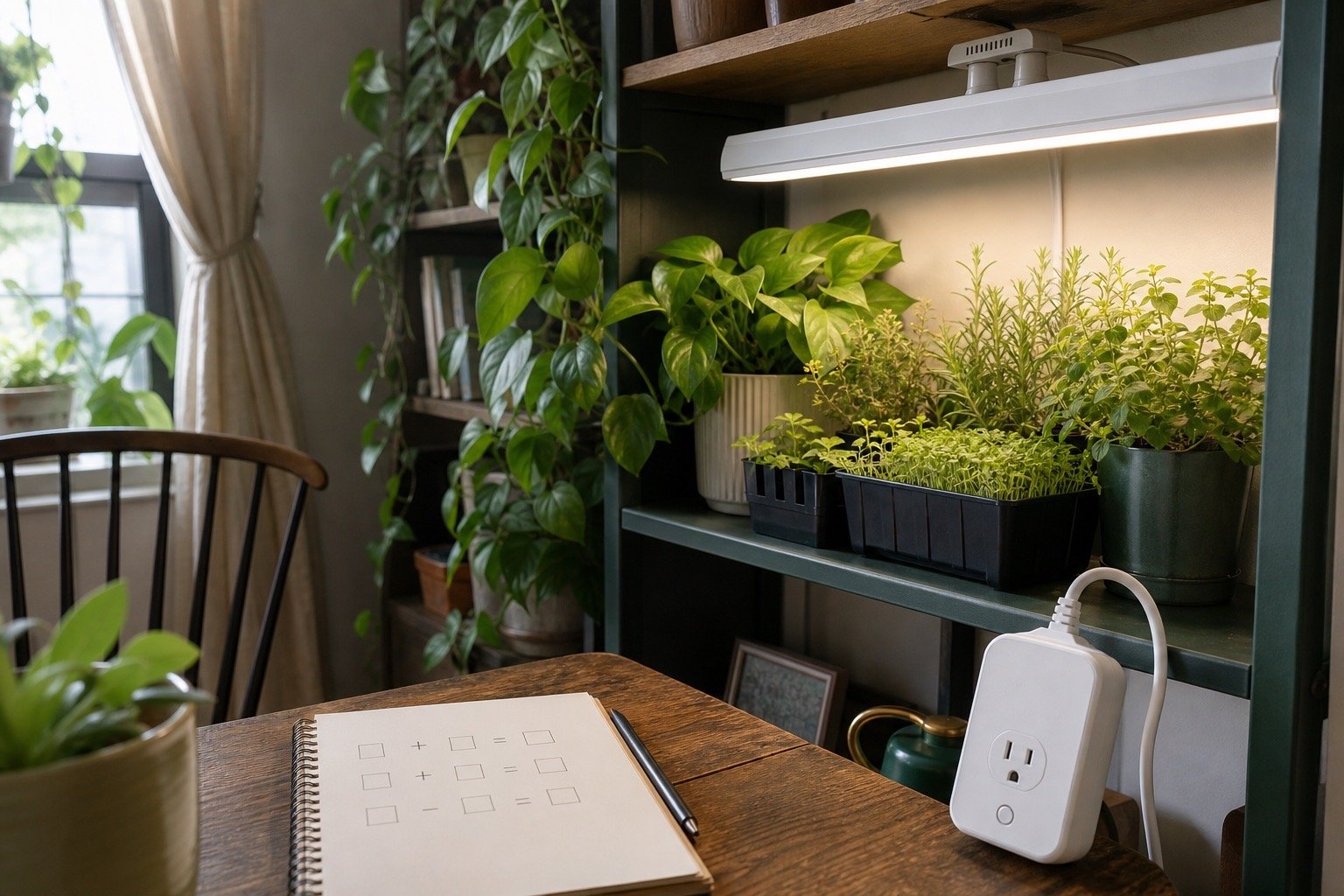
How much electricity do grow lights use? For a typical home setup, the answer can range from less than 1 dollar a month for a small 10 watt lamp to about 25 dollars a month for a 300 watt fixture running 16 hours a day. Your result depends on actual power draw, daily runtime, and the price on your electric bill.
The arithmetic is simple once you ignore the confusing parts of the product listing. A lamp described as a “1000W equivalent” may draw nowhere near 1,000 watts. For the bill, only the power pulled from the outlet matters.
The quick grow light electricity formula
Use this formula for one fixture:
Monthly cost = actual watts / 1,000 x hours per day x days used x electricity rate per kWh
For example, a 60 watt fixture running 14 hours a day for 30 days uses 25.2 kilowatt hours. At 17.3 cents per kWh, it costs about $4.36 for that month.
The 17.3 cent example is the 2025 US residential average reported by the US Energy Information Administration. It is only a reference point. EIA data also show large differences among states, so the rate printed on your own utility bill gives a better answer.
| Number you need | Where to find it | Common mistake |
|---|---|---|
| Actual watts | Product specifications or a plug in power meter | Using a model name or “equivalent wattage” |
| Hours per day | Timer setting or a written schedule | Counting the full day when the lamp turns off at night |
| Days per month | Usually 30 for a quick estimate | Forgetting seasonal changes |
| Price per kWh | Electric bill, utility portal, or state data | Using dollars per month for the entire home |
If your bill lists several charges tied to electricity use, the simple energy rate may slightly understate the change in your total bill. Fixed customer charges usually remain whether the grow light runs or not. Taxes, tiered pricing, and time of use plans can also change the final amount.
Five realistic grow light cost examples
These examples use actual draw, a 30 day month, and $0.173 per kWh. They are illustrations, not promises about a particular product.
| Actual draw and schedule | Monthly energy | Estimated monthly cost | Estimated annual cost |
|---|---|---|---|
| 10 W for 12 hours a day | 3.6 kWh | $0.62 | $7.48 |
| 30 W for 14 hours a day | 12.6 kWh | $2.18 | $26.16 |
| 60 W for 14 hours a day | 25.2 kWh | $4.36 | $52.32 |
| 100 W for 16 hours a day | 48 kWh | $8.30 | $99.65 |
| 300 W for 16 hours a day | 144 kWh | $24.91 | $298.94 |
Two identical 60 watt fixtures cost twice as much to run as one. A small circulation fan, water pump, heat mat, or humidifier belongs in a separate line of the calculation. Adding everything together gives the cost of the growing area rather than the lamp alone.
This is also why a tiny clip light and a shelf packed with seedlings should not share one vague cost estimate. Their power draw and schedules are different by an order of magnitude.
How much electricity do grow lights use at the wall?
The wattage in the product name is not always the wattage at the wall. Some sellers use an equivalent number to compare an LED with an older lamp. Others use a series name that happens to contain a large number. Neither number belongs in your electricity formula unless the specifications clearly identify it as input power, power consumption, or actual draw.
Look for wording such as “input power: 60 W.” If the listing gives a range, the light may draw less when dimmed. Drivers and controls also use a little power, so a measurement at the outlet is the cleanest check.
Measure actual draw instead of guessing
A plug in electricity meter sits between the outlet and the light. Many models show watts while the fixture is running and accumulate kilowatt hours over time. Let the light warm up, set it to the brightness you use, and record the watt reading. If the fixture has separate spectrum channels, measure the normal combination rather than the maximum setting you never use.
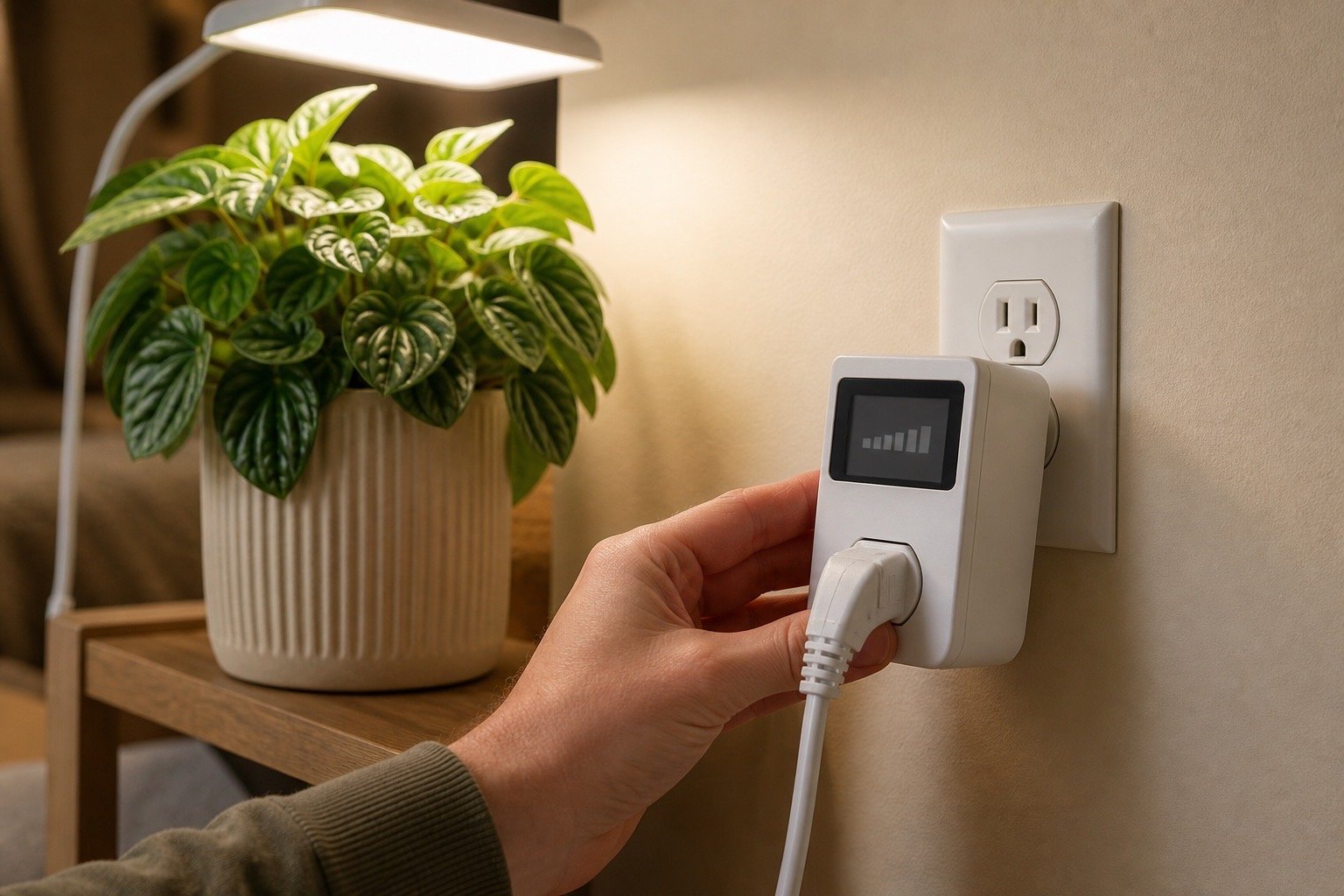
For a dimmable fixture, one quick measurement at each common setting can prevent bad estimates. Do not assume that a 50 percent dimmer position always cuts power draw exactly in half.
Search Amazon for a plug in electricity usage meter (paid link)
If you cannot measure the lamp, use the manufacturer’s stated input wattage and mark the result as an estimate. Keep the purchase listing or manual with your calculation, since online specifications can change.
Watts do not tell you how much light reaches a plant
Watts measure electrical power. They do not measure plant usable light at the leaves. The University of Minnesota Extension makes this distinction directly: PPF describes plant usable light emitted by a fixture, while PPFD describes how much arrives at a surface. Distance, coverage, optics, and fixture efficiency all affect the result.
A 30 watt lamp may be enough for one pothos and useless across a crowded four foot shelf. A more efficient fixture can deliver more usable light per watt than an inefficient one, but only across the area it covers well.
Use the PPFD and DLI guide to work backward from the plant’s light target. The grow light selector can help narrow the fixture type, while the guide to grow light distance deals with placement. Cost comes after the plant has a workable light plan.
Runtime changes the bill as much as wattage
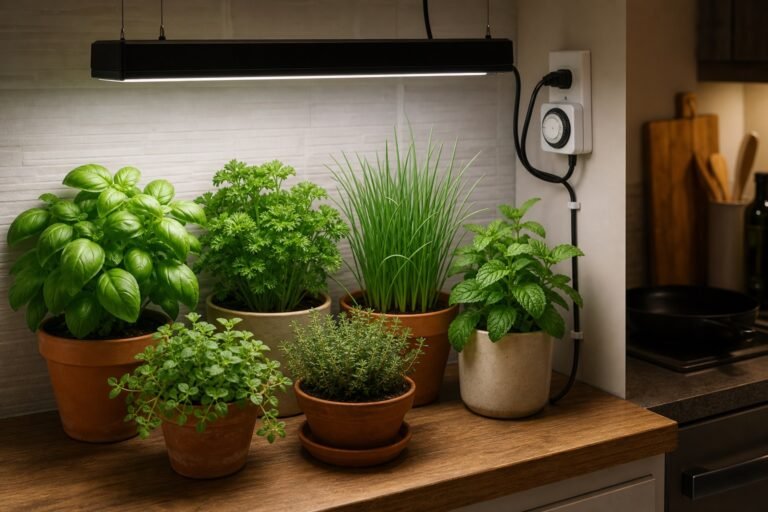
A timer makes runtime visible. It also gives plants a consistent dark period instead of leaving the lamp on whenever someone remembers the switch.
The right schedule depends on the crop, natural window light, intensity, and growth stage. The University of Minnesota lists 12 to 14 total light hours for hydroponic lettuce, herbs, and foliage houseplants, while seedlings may receive 16 to 18 hours. These are starting points, not a reason to force every plant onto the same timer.
Our guide to how long to leave a grow light on covers photoperiod in more detail. If leaves bleach, curl, or become unusually pale near the fixture, check whether plants are getting too much grow light before extending the day.
Search Amazon for a grounded outlet timer (paid link)
Compare two schedules
Suppose a 100 watt light runs 12 hours instead of 16. At $0.173 per kWh, the 12 hour schedule costs about $6.23 per 30 days. The 16 hour schedule costs about $8.30. That is a difference of roughly $2.07 a month.
Cutting four hours sounds like an easy saving, but it may reduce daily light below what the plants need. Measure or estimate DLI first. A shorter day at adequate intensity may work. A shorter day under an already weak lamp often produces stretched growth and a disappointing harvest.
A simple way to calculate a grow light shelf
List every electrical device separately. A sample shelf might contain:
- Two 40 watt LED bars running 14 hours a day
- One 8 watt fan running 12 hours a day
- One 5 watt pump running continuously
The two lights use 33.6 kWh in 30 days. The fan uses 2.88 kWh, and the pump uses 3.6 kWh. Total use is 40.08 kWh. At $0.173 per kWh, the shelf costs about $6.93 for the month.
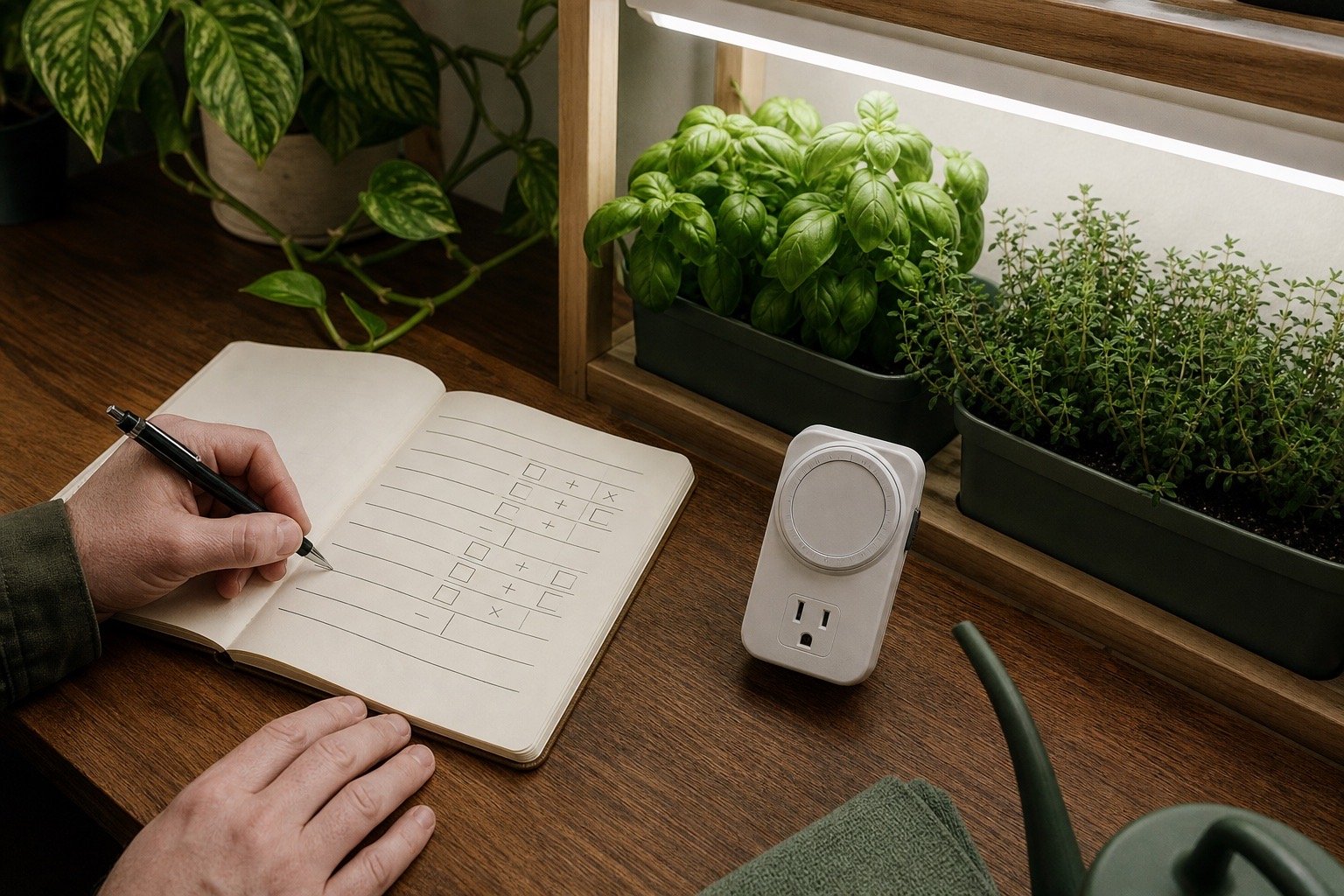
Write the result beside the date and schedule. If the bill later looks odd, you have something concrete to check. A pump that runs nonstop and a seasonal heat mat can be easy to forget.
What the formula leaves out
The lamp’s direct electricity use is only one piece of the room.
Heat and cooling
Every electrical device eventually adds heat to the space. A small LED over a few plants may make no noticeable difference. Several powerful fixtures in a closed room can add to air conditioning demand. In winter, that heat is not necessarily wasted, but it is not a substitute for safe, controlled home heating.
The cost examples above do not include heating or cooling changes because rooms, climates, and HVAC systems differ too much for one honest number.
Time of use pricing
Some utilities charge different rates by time of day. A timer could move part of the lighting period into a cheaper window, provided the schedule still gives the plants a consistent day and night. Check the plan rules first. Do not assume nighttime electricity costs less everywhere.
Standby draw
Smart plugs, digital timers, and fixture controls can draw a small amount while idle. A power meter can capture that use. For one home light it is often minor compared with the lamp, but measuring is better than arguing about a fraction of a watt.
How to lower grow light cost without starving plants
Start with wasted coverage. Light falling on the floor, wall, or an empty section of shelf still appears on the electric bill. Group plants with similar needs, adjust the hanging height, and choose a fixture whose lit area matches the canopy.
Keep leaves and fixtures clean enough that dust is not blocking light. Use a timer, and review the schedule when natural daylight changes. A bright summer window may reduce the supplemental hours needed for some plants. Winter can reverse that calculation.
When comparing new fixtures, look for actual input watts plus credible PPF or PPFD information over a stated area. A large “equivalent wattage” number tells you little about efficiency. Our guide to choosing apartment grow lights explains the practical tradeoffs among footprint, glare, heat, and placement.
Search Amazon for LED grow lights that state actual wattage (paid link)
Do not replace a working, suitable LED merely to save a few watts without doing the math. The purchase price can exceed years of small energy savings. First calculate the old light, the proposed light, and the difference.
Frequently asked questions
How much does a 100 watt grow light cost per month?
At 16 hours a day for 30 days, a 100 watt light uses 48 kWh. At $0.173 per kWh, that is about $8.30. Multiply 48 by the rate on your own bill for a local estimate.
Does a 1000W grow light always use 1,000 watts?
No. Some product names and listings use equivalent wattage or a model number. Find the stated input power or measure draw at the outlet. If the fixture truly draws 1,000 watts, one hour of use equals 1 kWh.
Are LED grow lights expensive to run?
Small LED grow lights are often inexpensive to run, but size and runtime matter. A 10 watt lamp and a 300 watt fixture are both LEDs, yet their monthly energy use differs sharply. Calculate actual draw rather than judging the technology label alone.
Can I leave a grow light on 24 hours a day?
Continuous light raises cost and is not the default recommendation for common indoor plants. Many plants need a dark period, and Extension schedules generally include one. Choose a plant appropriate photoperiod, then use a timer.
Will a dimmer reduce electricity use?
Usually, but the reduction may not match the percentage printed around the knob. Measure the fixture at the setting you use. Dimming also reduces light output, so check the canopy rather than treating lower watts as a free saving.
Is a watt meter necessary?
No. The manufacturer’s actual input power can produce a reasonable estimate. A meter is useful when a listing is unclear, a fixture is dimmed, or several devices share one growing area.
The number worth remembering
One kilowatt hour is 1,000 watts used for one hour. Once that clicks, grow light cost stops being mysterious.
Use actual draw, count the real runtime, and multiply by your local rate. Then check that the light still serves the plant. The cheapest schedule is not a bargain if it leaves seedlings stretched or herbs too weak to harvest.
Related guides and tools
Sources and further reading
Sources were checked August 12, 2026.
- US Energy Information Administration: electricity prices and factors
- US Energy Information Administration: Electric Power Monthly, Table 5.3
- US Department of Energy: energy and kilowatt hour definitions
- University of Minnesota Extension: lighting for indoor plants and starting seeds
- University of Minnesota Extension: starting seeds indoors