
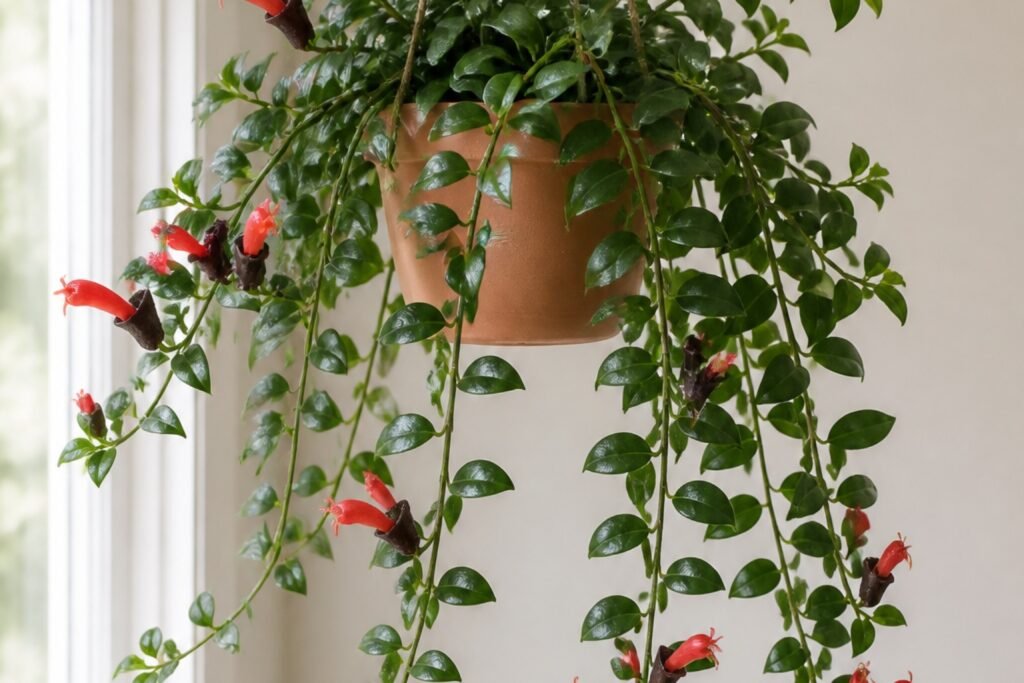
Lipstick plant care indoors is mostly a balance between enough light for flowers and enough moisture to keep the trailing stems firm. Aeschynanthus radicans is an epiphyte from wet tropical parts of Southeast Asia. It makes waxy green leaves and red tubular flowers that emerge from dark buds, which explains the common name.
The name is not precise across the plant trade. Other Aeschynanthus species and hybrids are also sold as lipstick plant. This profile covers A. radicans, so check the botanical label before applying its identity or safety notes.
Lipstick plant care indoors at a glance
| Care point | Practical indoor target |
|---|---|
| Light | Bright indirect light, with gentle morning sun if acclimated |
| Water | Water when the upper inch is dry and the pot feels lighter |
| Soil | Loose, organic epiphyte mix with fast drainage |
| Humidity | Moderate to high, with air moving around leaves and flowers |
| Temperature | About 60 to 80 F |
| Mature indoor size | Trailing stems roughly 2 to 3 feet long |
| Growth rate | Moderate |
| Pet safety | Not independently verified for exact Aeschynanthus radicans |
Lipstick plant care indoors needs flowering light
A bright east window is a useful starting point. A spot back from south or west glass can also work if hot midday rays do not strike the leaves. Too much direct sun leaves bleached or crisp patches. Too little light produces long gaps between leaves and few flower buds.
Judge the newest section of vine. Compact leaves and buds suggest the light is useful. A long pale runner searching toward the window suggests it isn't. Move the basket gradually because foliage grown in shade can scorch after one sunny afternoon. The grow light guide helps when winter daylight is the missing piece.
Do not keep relocating a plant once buds have formed. Abrupt changes in light, temperature, or root moisture can interrupt flowering.
Water when the upper inch dries
Press into the upper inch and lift the basket or inner pot. Water when that layer is dry and the container feels lighter, while the deeper root zone is not hard and shrunken. Soak the mix, let excess drain, and keep the nursery pot out of standing water.
An active plant in bright warmth uses water faster than the same basket in a cool winter room. Hanging containers also dry around the edges before a heavy center dries. Feel more than one point and use the cue-based routine in how often to water indoor plants instead of a weekly promise.
Soft, wrinkled leaves on a light pot point toward dryness. Soft leaves on wet mix call for a root check. If the pot stays heavy and smells sour, improve drainage and air movement. Letting the entire plant remain bone dry can trigger leaf and bud drop.
Use an epiphyte-friendly potting mix
The roots need a loose organic blend that holds some moisture but drains quickly. Dense soil stays wet around the center of a hanging basket. A blend that is all large bark may dry before the plant can use the water. The potting soil comparison explains how to adjust common indoor mixes.
Choose a pot only a little larger than the root mass. Repot when roots crowd the container, the inner mix collapses, or drainage becomes patchy. A huge pot adds a wet buffer the plant did not ask for. Follow the measured increase in the repotting guide and keep the stem bases at their old depth.
Feed lightly during active growth with a dilute complete fertilizer, following its label. Strong fertilizer on dry roots can burn them. If growth is lush but flowers are scarce, check light before adding more feed.
Propagation is by stem cuttings. Take a healthy section with several nodes, remove the lowest leaves, and root the lower nodes in an airy medium. The plant can also root in water, but transfer before the water roots form a large tangled mass. Our water propagation guide covers that transition.
Humidity should come with airflow
Moderate to high humidity keeps new leaves from drying too quickly. A room humidifier is more predictable than spraying flowers and foliage. Leave room around a hanging basket so wet leaves dry. Stagnant moist air encourages Botrytis and leaf spots.
A room-scale humidity change works better than an occasional spray. Start with distance from heaters, then measure the actual humidity rather than guessing. Water on leaf surfaces is not the same thing as moisture in the air.
Do not crowd several long vines tightly against a wall. Air should reach the middle of the basket, where old leaves and spent flowers can collect.
Common Lipstick plant problems
| Symptom | Likely checks | First sensible move |
|---|---|---|
| Few or no flowers | Weak light, excess nitrogen, or recent disturbance | Check the newest stem spacing and window exposure |
| Wrinkled soft leaves | Dry roots, heat, or root damage | Lift the pot and feel below the surface |
| Yellow leaves on wet mix | Poor drainage or declining roots | Empty the cachepot and inspect the root zone |
| Tan spots on leaves or flowers | Sun scorch, wet foliage, or fungal disease | Compare position and drying conditions |
| Cottony clusters or sticky residue | Mealybugs or aphids | Isolate and inspect leaf joints and buds |
Mealybugs can hide where leaves meet the stem and around flower clusters. Confirm the pest before spraying a plant in bloom. The mealybug guide covers repeated inspection and treatment choices.
Prune a long bare stem just above a healthy node during active growth. The cut encourages branching, but it cannot fix weak light. Keep several productive stems rather than shearing the entire basket at once.
Pet and household safety
No exact preferred veterinary record for Aeschynanthus radicans was verified during this review. The ASPCA page titled Lipstick Plant identifies Aeschynanthus humilis, a different species. Its non-toxic listing should not be transferred to A. radicans as exact proof.
The database therefore marks cat and dog safety as not verified. Keep vines and fallen flowers away from habitual chewers, and contact a veterinarian if a pet develops symptoms. The pet-safe indoor plant guide explains why a matching common name is not enough.
Frequently asked questions
Why is my Lipstick plant not flowering?
Weak light is the first thing to check. Look for long gaps between leaves and pale growth. Root stress, excess nitrogen, and sudden moves after bud formation can also reduce flowering.
How often should I water a Lipstick plant?
Use the pot, not the calendar. Water when the upper inch is dry and the container feels lighter, then drain it completely. Light, temperature, pot size, and season change the interval.
Should I mist a Lipstick plant?
Misting briefly wets the leaves but does not maintain room humidity. A humidifier is more useful in a dry room. Pair added humidity with enough airflow for foliage and flowers to dry.