How to Fertilize Houseplants (Without Overdoing It and Burning Them)
Last updated: 21.06.2026.
Fertilizing is the part of houseplant care that confuses people most, and it splits them into two camps. One camp never feeds their plants at all and wonders why they stall after a year. The other camp feeds constantly out of love and slowly burns their plants with salt buildup. The truth sits in a calm middle, and once you understand it, feeding plants becomes simple.
Start here: For a complete overview, see our Indoor Gardening for Absolute Beginners.
Here is the plain version: potted plants live in a finite scoop of soil, and they use up its nutrients over time. Fertilizer replaces what they use. That is the whole concept. The skill is just knowing how much, how often, and when to stop. Here is everything you actually need.
Why potted plants need feeding at all
An outdoor plant has the whole earth to pull nutrients from. A potted plant has a few cups of soil, and once it has used up what is there (usually within a couple of months of fresh mix), there is no more coming unless you add it. A plant that stops growing, pales, or has small new leaves a year after potting is often just hungry.
That said, fertilizer is not plant food in the way people think. Light is the plant’s food. Fertilizer is more like vitamins and minerals. So feeding a plant sitting in a dark corner will not make it grow, it will just build up unused salts. Light first, then nutrients.
Reading a fertilizer label: N-P-K
Every fertilizer shows three numbers, like 10-10-10 or 5-3-3. That is the N-P-K ratio, and it is simpler than it looks:
- N (Nitrogen): leaves and green growth. The big one for leafy houseplants.
- P (Phosphorus): roots and flowers.
- K (Potassium): overall health and resilience.
For most leafy houseplants, a balanced ratio (like 10-10-10) or one slightly higher in nitrogen is perfect. A general-purpose balanced liquid houseplant fertilizer covers the vast majority of plants. You do not need a shelf of specialty bottles to start.
The types of fertilizer, and which to pick
Liquid fertilizer. Mixed into water and applied when you water. Fast-acting and easy to control, which makes it the best choice for beginners since you can dilute it and stop anytime. My default recommendation.
Slow-release granules or pellets. Mixed into the soil, they release nutrients gradually over months. Convenient and hard to overdo, good if you forget to feed. A box of slow-release plant food lasts a long time.
Organic options. Worm castings mixed into the soil, or gentle organic liquids like seaweed or fish emulsion. Mild, forgiving, and they will not burn roots. Worm castings are my favorite low-effort feed.
Any of these works. The mistake is not which type you pick, it is feeding too much of it.
How often to feed (the part that matters most)
Here is the rule that keeps you out of trouble: feed during the growing season, ease off or stop in winter.
- Spring and summer (roughly March to September): this is when plants actively grow and use nutrients. Feed with diluted liquid fertilizer every 2 to 4 weeks, or use slow-release granules that last the season.
- Autumn and winter (roughly October to February): plants slow down or go dormant, so they need little or no feeding. Overfeeding a resting plant just builds up salt. Stop or greatly reduce. This is part of the wider seasonal shift covered in winter houseplant care.
And the golden rule: dilute more than the bottle says. Most labels suggest stronger doses than houseplants need. Using fertilizer at half the recommended strength is safer and still effective. When in doubt, less.
The signs you are overfeeding
Too much fertilizer is more harmful than too little. Watch for:
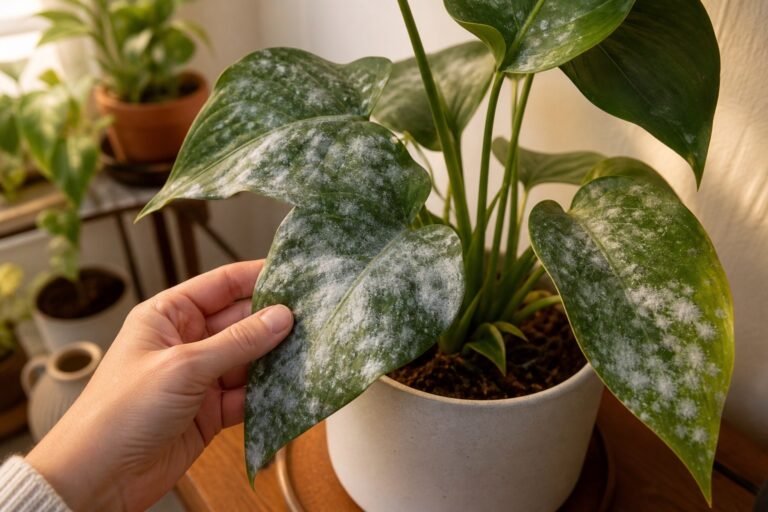
- A white crust on the soil surface or around the pot rim (salt buildup)
- Brown, crispy leaf tips or edges (fertilizer burn), which has several causes covered in brown tips on houseplant leaves
- Yellowing or wilting despite correct watering, sometimes a sign of root damage from salts (see also why leaves turn yellow)
- A sudden stall in growth
If you see salt buildup, flush the soil: run water through the pot several times to wash out excess salts, let it drain fully, and then ease off feeding. Plants recover from underfeeding quickly; overfeeding damage takes longer to undo.
A few practical rules to never go wrong
- Never fertilize bone-dry soil. Water first, or feed with already-diluted fertilizer water, so you do not shock or burn dry roots.
- Do not feed a stressed plant. A newly repotted, sick, or recovering plant should not be fed until it is settled and growing. Feeding stressed roots makes things worse.
- Fresh mix already has nutrients. A plant in fresh potting soil usually does not need feeding for the first month or two. The repotting guide covers when soil is fresh.
- Less is more. If you remember nothing else: dilute, feed during growth, stop in winter, and skip a feeding when unsure.
Fertilizing is not the dark art it seems. Feed lightly during the growing months, lay off in winter, dilute more than you think, and watch for salt buildup. Do that and your plants get the steady nutrition they need without the burn. Combined with right-sized watering and enough light, it is the last piece of keeping houseplants not just alive but genuinely thriving.