How to Get Rid of Thrips on Houseplants: 7 Safe Steps
Last updated: August 7, 2026.
Affiliate disclosure: As an Amazon Associate I earn from qualifying purchases. Links marked "paid link" may earn Fern & Shelf a commission at no extra cost to you. Read our full Affiliate Disclosure.
Start here: For a complete overview, see our Indoor Gardening for Absolute Beginners.
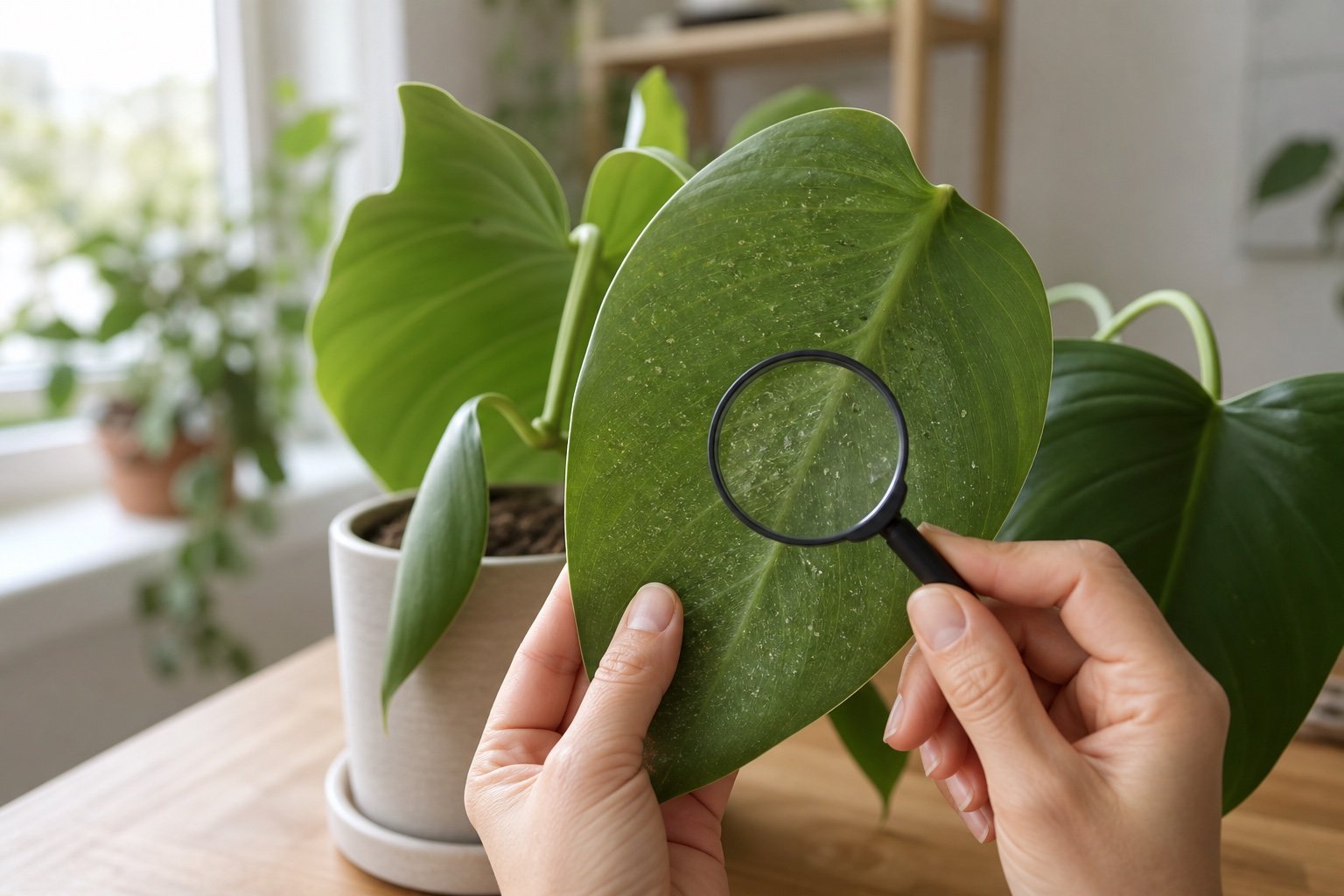
How to get rid of thrips on houseplants starts with finding the insect, not reaching for a spray. Thrips are tiny and often feed inside folds, buds, and fresh growth. Their feeding can leave pale or silvery scars, distorted leaves, and dark specks of waste, but those symptoms can overlap with mites, poor care, or physical damage.
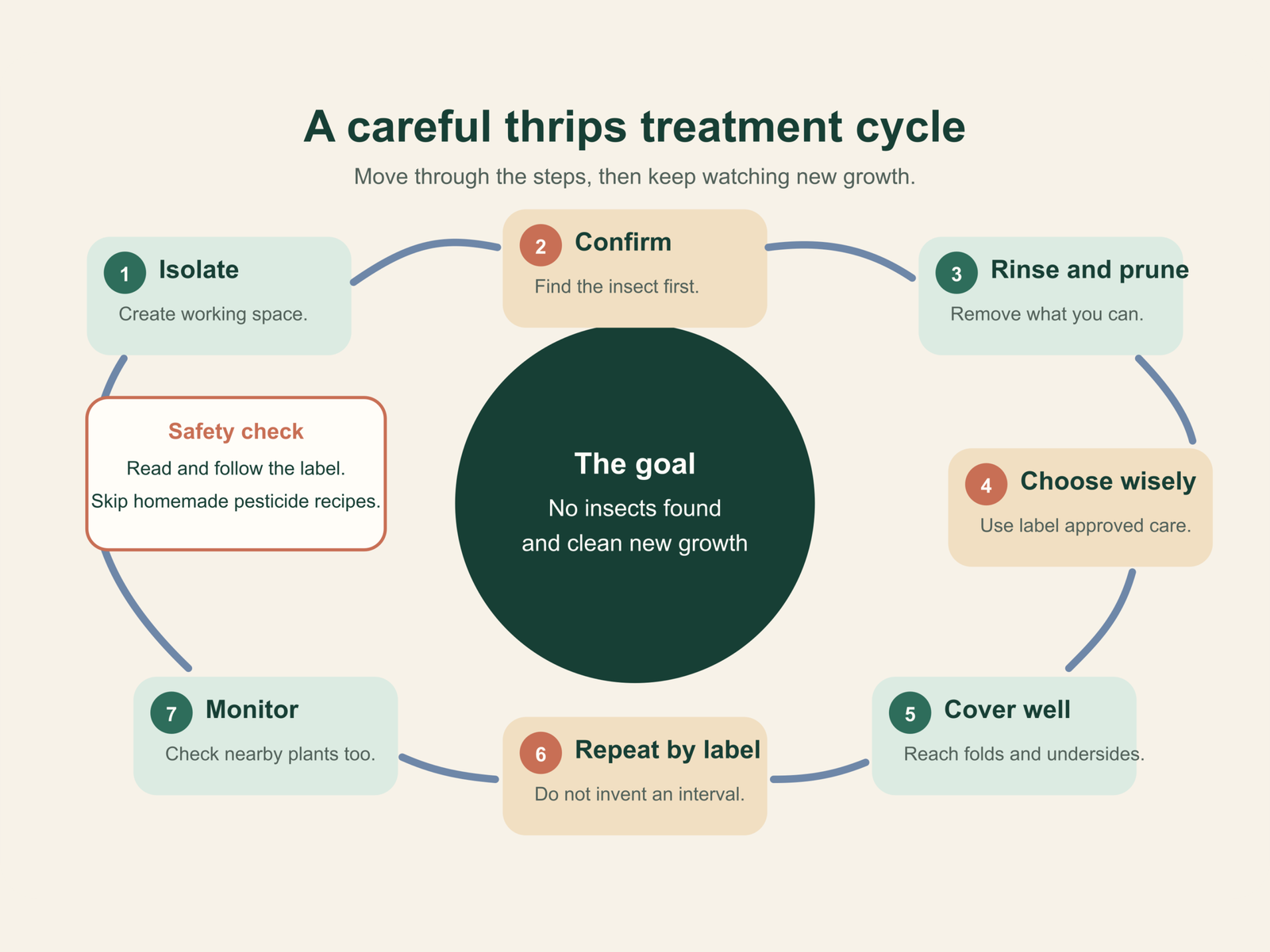
The useful answer to how to get rid of thrips on houseplants is a repeated IPM cycle: isolate the plant, confirm the pest, remove what you can, choose the least toxic suitable treatment, follow its label, and keep checking. One hurried application often misses eggs inside plant tissue or thrips hidden beyond the spray.
The seven-step plan at a glance
| Step | Action | Reason |
|---|---|---|
| 1 | Isolate the plant | Reduce contact with the rest of the collection |
| 2 | Confirm thrips | Similar leaf damage can have other causes |
| 3 | Rinse and prune | Remove exposed insects and badly infested tissue |
| 4 | Choose a labeled option | Match the product to the plant, place, and pest |
| 5 | Apply with complete coverage | Contact products work only where the spray reaches |
| 6 | Repeat by the label | Hidden stages and new hatchlings can survive the first pass |
| 7 | Monitor new growth | Old scars stay visible even after the population falls |
Confirm thrips before treating
Thrips are slender insects, usually pale yellow, brown, or dark, and easy to miss without magnification. UC IPM describes houseplant thrips as less than 1/8 inch long. Most adults have narrow fringed wings, although some thrips species have wingless adults. Immature stages are wingless. Look along the main vein, under leaves, in flowers, inside folded new leaves, and where a leaf stalk meets the stem.
Damage alone is not enough. Silvery streaks and fine stippling can resemble spider mite damage. Young leaves may curl for several reasons, so use the leaf curling diagnosis guide before blaming a pest you cannot find. Dark, varnish-like dots beside pale scars make thrips more plausible, but the insect itself is better evidence.
Hold clean white paper beneath suspect growth and gently tap or shake the leaf. A dislodged thrips looks narrow rather than round and may run quickly. A hand lens makes the body shape easier to see.
Search Amazon for a 10x hand lens for plant pest checks (paid link)
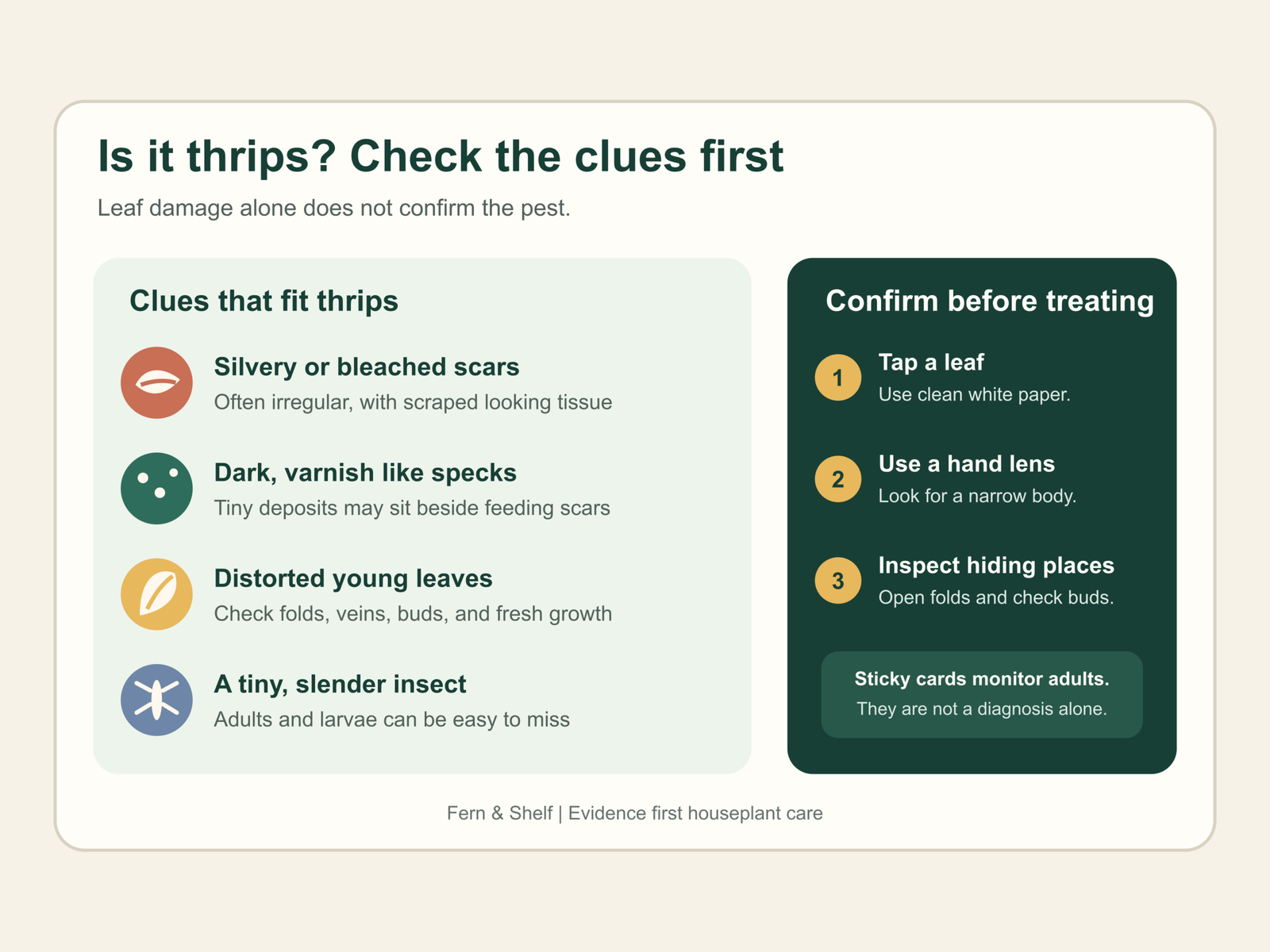
Blue or bright yellow sticky cards can detect flying adults. They monitor adult movement. Diagnosis and treatment still require plant inspection.
Search Amazon for blue sticky cards for thrips monitoring (paid link)
How to get rid of thrips on houseplants in 7 steps
1. Isolate the affected plant
Move the plant away from healthy plants as soon as you find a likely pest problem. UC IPM advises immediate isolation for insect, mite, or disease trouble on an established houseplant, followed by hand washing after contact. Choose a spot where leaves cannot brush against the rest of the collection and where you can inspect every side of the pot.
Check plants that shared the shelf, windowsill, or grow cabinet. Do not wait for visible silvering because early populations may cause little obvious damage. The site's new houseplant quarantine routine covers prevention before a plant joins the collection; this treatment plan begins after thrips are suspected or confirmed.
Decide whether the plant is worth treating. A small population on a valued plant may justify careful work. Both Maryland Extension and UC IPM note that a heavily infested houseplant can be simpler to discard than rescue. Removing one plant can protect a larger collection.
2. Inspect the whole plant and record a baseline
Confirm at least one insect where possible, then inspect flowers, buds, new leaves, leaf undersides, veins, and stem joints. Photograph the most recent growth and note where you found insects or fresh scars. That baseline matters because old injury will not turn green again.
Look at nearby plants with the same white-paper test. Mealybugs are easier to see and usually leave cottony material, while thrips are narrow and fast. The mealybug treatment guide keeps that separate diagnosis from this one.
Do not assume every thrips on a sticky card means every plant needs pesticide. UC IPM notes that trapped adults do not necessarily mean feeding damage will follow. Treat a plant when you find the insects there or fresh feeding signs that match them.
3. Rinse and prune before considering pesticide
Take the plant to a sink or another suitable washing area. Use plain water to knock exposed thrips from both sides of the leaves and stems. Support tender growth and use enough pressure to dislodge insects without tearing the plant.
Remove badly distorted leaves or heavily infested flowers when the plant can spare them. Thrips can hide deep in blooms and tight new growth, beyond the reach of a contact spray. Clean pruning tools after use, dispose of removed material, and wash the work area.
This is pest removal, not cosmetic polishing. The houseplant leaf cleaning guide explains routine dust removal, but an infestation calls for isolation and repeated inspection as well. Do not coat leaves with shine products or a homemade mixture.
4. Choose the least toxic suitable product
Any pesticide plan for how to get rid of thrips on houseplants must begin with the label. The product needs to name or cover the pest, the plant or crop, and the place of use. A spray labeled for outdoor ornamentals is not automatically legal or suitable for a houseplant inside a home. If the plant is an edible herb, the crop and any harvest restrictions must also fit.
University of Maryland Extension lists horticultural oil and insecticidal soap among lower toxicity options. UC IPM's houseplant guidance also recommends considering those products before broader insecticides when the product is labeled for the plant and pest. Spinosad can be more effective against some thrips, but formulations and allowed sites differ, and UC IPM warns about harm to bees and some natural enemies.
Search Amazon for ready-to-use insecticidal soap options for label review (paid link)
An Amazon search result is not a label check. Read the current container label before buying and again before using. Skip household dish soap, detergent, essential oil blends, and improvised pesticide recipes. Maryland Extension specifically advises against household soap or detergent and against combining sprays.
5. Follow the label and reach hiding places
The EPA explains that a pesticide label defines where, how, how much, and how often the product may be used. Its directions may also set protective equipment, ventilation, reentry, storage, and disposal requirements. Follow all of them.
If the label allows the application, cover the leaf undersides, buds, shoot tips, and other listed plant parts where thrips hide. Contact sprays work only when they reach the insect. UC IPM stresses thorough coverage for contact products. More spray than the label permits is not better treatment.
Follow any label directions about keeping people and pets away during or after application. Protect nearby surfaces as directed. Apply only in the location named on the label. Permission for outdoor use does not authorize use inside a home. Do not combine sprays.
6. Repeat only at the label interval
Thrips can survive a first application because adult females insert eggs into plant tissue. Maryland Extension reports that juveniles may pupate on leaves, in potting mix, or in debris. Contact sprays can also miss insects tucked into a folded leaf.
That biology is why repeated inspection matters. It is not permission to invent a schedule. Use the interval, maximum number of applications, and any other limits on the product label. Temperature and species affect development, so a universal "spray every seven days" rule is not dependable.
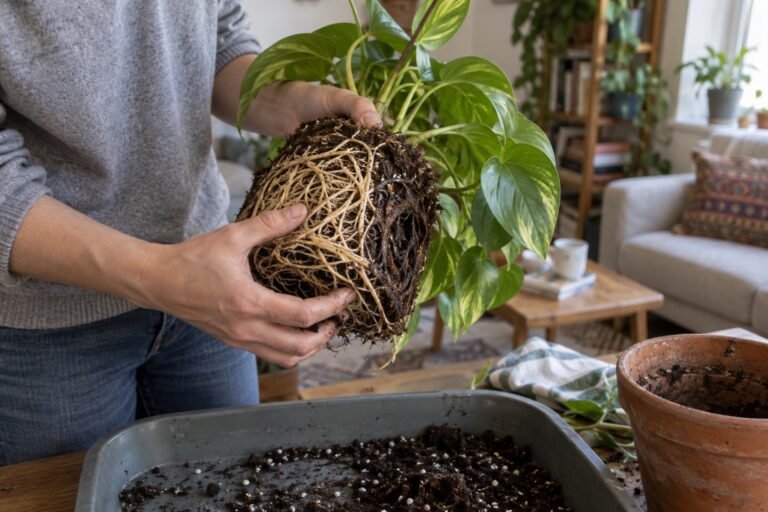
Repotting is not a substitute for this cycle. It might remove some pupae in the mix, but Maryland Extension notes that it will not affect thrips elsewhere on the plant. Repot only when there is a separate reason and when the extra root disturbance will not make a stressed plant harder to assess.
7. Monitor insects and new growth
Keep the plant isolated while you complete the label-directed course and continue inspections. Repeat the white-paper test, and check leaf undersides, buds, and the newest growth. Replace sticky cards when their instructions call for it, and compare catches over time rather than treating one card as a cure.
Sticky cards may also catch fungus gnats, which spend their larval stage in moist potting mix and need a different plan. The fungus gnat guide explains that separate life cycle.
Judge progress by fewer insects and clean new growth. Existing silver scars, yellow areas, and distorted tissue may remain. If insects continue to appear after correct label use, reassess the identification, whether the spray reached hiding places, and untreated nearby plants. A local Cooperative Extension office can help with a specimen. Discarding a plant remains reasonable when the infestation is heavy, the plant keeps declining, or treatment would expose the household to more pesticide use than the plant warrants.
Mistakes that keep a thrips problem going
- Treating a scar without finding the pest. Mites, care problems, and old mechanical injury can resemble thrips damage.
- Using a sticky card as the whole treatment. Cards catch some flying adults but miss eggs, larvae, and hidden insects.
- Applying one contact spray and stopping. The label may require repeat applications because coverage and life stages limit the first pass.
- Repotting as the only response. Soil work cannot remove thrips feeding in buds or leaves.
- Pushing new growth with extra fertilizer. Maryland Extension advises against overfertilizing because tender growth can be more attractive to thrips.
- Mixing products or copying a home recipe. A pesticide mixture can injure the plant, increase exposure, and conflict with the label.
Frequently asked questions
Can thrips live in houseplant soil?
Some species or life stages can pupate in potting mix, while eggs may sit inside plant tissue and feeding stages remain on leaves or flowers. That is why a soil-only response is incomplete. Inspect and manage the entire plant, and follow the selected product's labeled directions.
Does dish soap get rid of thrips?
Do not substitute dish soap or detergent for a registered insecticidal soap. Household products do not carry pesticide directions for that use. Use plain water for the mechanical rinse, then choose a pesticide only when its label covers the pest, plant, and indoor site.
Are blue sticky traps enough for thrips?
No. UC IPM recommends blue or bright yellow cards to detect flying thrips, but cards do not reach eggs or insects inside buds and folded leaves. Use them to monitor alongside inspection, rinsing, pruning, and label-directed treatment when needed.
How long does thrips treatment take?
There is no fixed household timetable. Maryland Extension notes that development from egg to adult can take about a month in cool conditions and two weeks or less in warm conditions. Species, room temperature, hiding places, treatment coverage, and the label interval all change the practical timeline.
Can thrips-damaged leaves recover?
The damaged tissue will not return to its old appearance. UC IPM advises judging results by the end of new injury and the arrival of healthy new growth. Remove an old leaf only when it is dead, badly infested, or the plant can lose it without excessive stress.
What is the safest way to learn how to get rid of thrips on houseplants?
Use IPM in order. Confirm the pest, isolate the plant, rinse and prune, then use the least toxic effective option whose current label covers thrips, the plant, and the application site. Follow its rate, protective equipment, interval, and disposal directions exactly.
How to get rid of thrips on houseplants without guessing
In practice, how to get rid of thrips on houseplants comes down to evidence and repetition. Find the insect, separate the plant, remove exposed thrips, and let the pesticide label set every chemical step. Keep watching the newest leaves. They tell you more about the current population than an old silver scar ever will.