Why Are My Plant Leaves Curling? 8 Checks Before You Treat
Last updated: July 23, 2026.
Why are my plant leaves curling? A curl by itself is not specific enough. A thirsty plant can curl. So can a plant with injured roots, aphids on new growth, excess fertilizer salts, a cold draft, or a virus. Some plants also unfurl new leaves slowly, and a single odd leaf may never point to a larger problem.
Start here: For a complete overview, see our Indoor Gardening for Absolute Beginners.
Do not treat the shape first. Look for a pattern. Which leaves changed? How do they feel? What is happening in the pot? Did the plant move, get repotted, or receive fertilizer? Are there insects, stippling, sticky residue, silver scars, mottling, or soft roots?
This guide uses eight checks in that order. Most cases become clearer before you reach the last one, and that is useful because it keeps you from stacking water, fertilizer, pesticide, and repotting onto a plant that needed only one careful change.
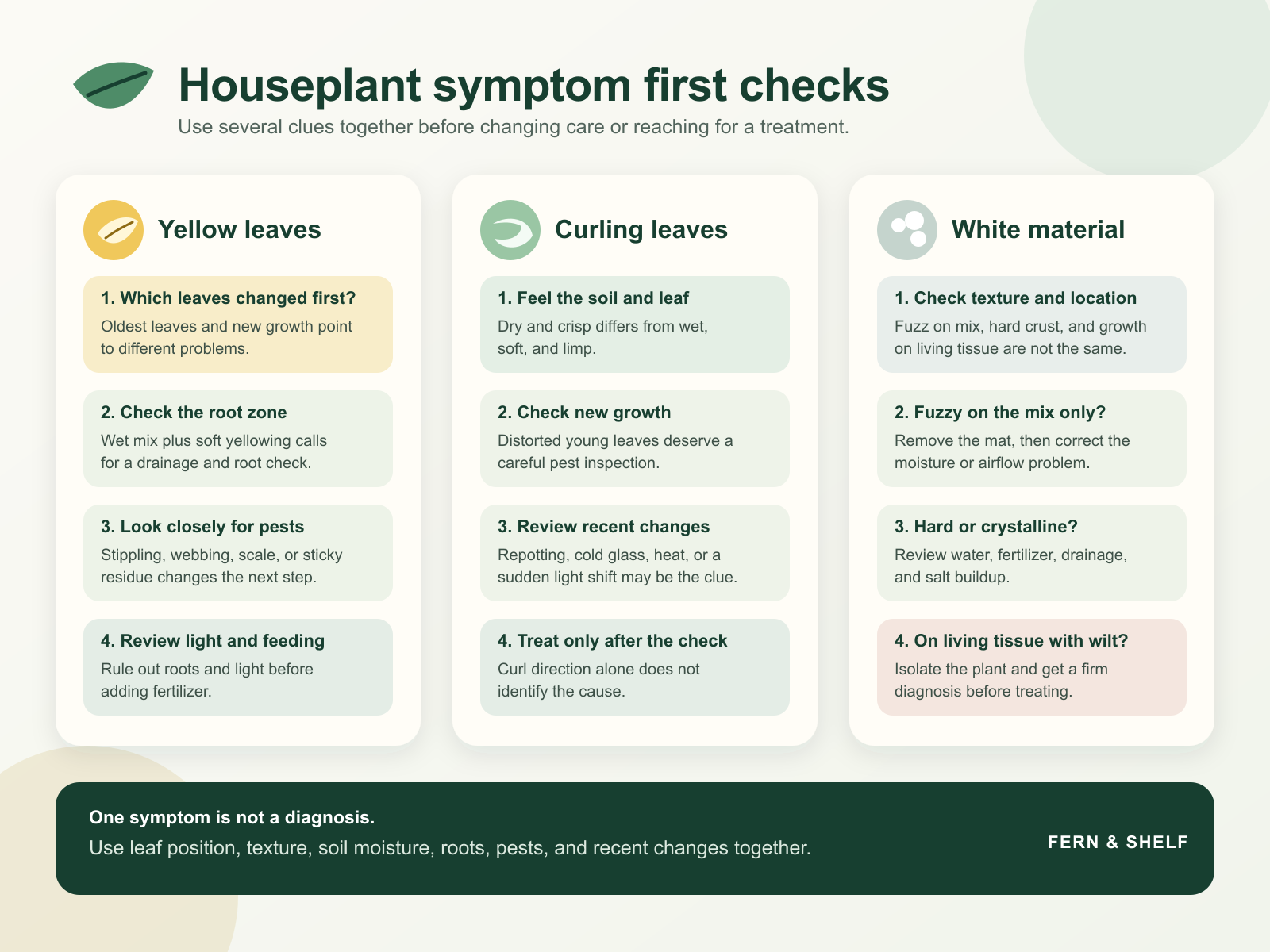
Why are my plant leaves curling? Start with this matrix
| Pattern | Best next check | Possible cause group |
|---|---|---|
| One old leaf curls, while the rest of the plant looks normal | Mark the leaf and watch new growth | Normal aging, old injury, or an isolated event |
| Leaves feel dry or crisp and the pot is unusually light | Check moisture through the root zone | Underwatering, heat, low humidity, or damaged roots |
| Leaves are soft or limp and the mix stays wet | Check drainage and roots | Low oxygen, root stress, or root rot |
| New leaves are twisted, puckered, sticky, stippled, or silvered | Inspect with a hand lens | Aphids, mites, thrips, mealybugs, scale, or another feeding pest |
| Tip burn or wilt appears with a white crust on the soil or pot | Review water and fertilizer history | Soluble salt injury or excessive fertilizer |
| Curling began soon after a move, cold night, repot, or light change | Build a timeline | Acclimation, root disturbance, temperature, or light stress |
| Distortion comes with mosaic, mottling, ringspots, vein clearing, or stunting | Isolate and seek diagnosis | Possible virus or other systemic disease |
| The problem keeps spreading despite stable care | Document the whole plant and contact a diagnostic lab | Pest, root disease, chemical injury, or another less common cause |
Curling upward versus downward can help describe the symptom, but it does not settle the cause. Virginia Cooperative Extension notes that curling or puckering may come from feeding insects, while waterlogging, drought, heat, chemicals, and pathogens can produce overlapping damage. Use the rest of the plant to narrow the list.
Check 1: Is this one leaf or a plant-wide change?
Start with leaf age and distribution. One curled lower leaf on a plant that is otherwise growing normally is different from every new leaf emerging twisted. A leaf that was bent against a window, bruised during transport, or damaged while unfurling will not flatten just because the cause has passed.
- One old leaf: photograph it and watch. Remove it only if it is mostly dead or damaged.
- Several leaves on one side: look for a nearby window, heater, vent, cold pane, spray, or physical contact.
- Only new growth: inspect closely for feeding pests, chemical injury, nutrient imbalance, or systemic disease.
- Most of the plant at once: check the root zone, temperature history, and recent care changes before treating individual leaves.
Mark one affected leaf with a loose piece of string and take a weekly photo from the same angle. Old damage may stay visible, so judge the result by the next leaves the plant makes.
Check 2: Read the pot before adding water
A dry-looking leaf does not prove that the pot needs water. Roots damaged by saturated or compacted media cannot supply the top of the plant well, so an overwatered plant may wilt or curl while the mix remains wet.
Clues that point toward a dry root zone
- The pot is much lighter than it is after watering.
- The mix is dry through the depth where most roots sit, not only on top.
- Leaves feel thin, dry, or crisp, and the change followed heat or a missed watering.
- Water runs around a shrunken root ball without wetting it evenly.
Water thoroughly when the plant and root zone call for it, then let the pot drain. If dry media has pulled from the sides, apply water slowly in more than one pass. The article on how often to water indoor plants explains how to use moisture and pot weight instead of a calendar.
Clues that point toward root stress in wet media
- The pot remains heavy for many days.
- The container lacks an open drainage hole or sits in runoff.
- Leaves are limp, pale, yellowing, or dropping while the mix is wet.
- Roots are brown to black, soft, limp, or easy to pull apart.
Wet soil alone does not prove root rot. If the plant is declining and the pot does not dry, slide out the root ball and inspect it. The overwatered plant guide covers the root check and the point at which fresh media is justified.
Check 3: Build a seven-day change log
Timing often tells you more than curl direction. Write down anything that changed during the week before the symptom appeared:
- repotting, root pruning, division, or a fall from the shelf;
- a move closer to a window or under a stronger grow light;
- a cold night, heater startup, air conditioner, or open window;
- fertilizer, pesticide, leaf shine, cleaner, or a homemade spray;
- a missed watering or several unusually frequent waterings;
- a new plant joining the collection.
Recent repotting deserves patience when the roots are healthy and the problem is mild. Keep conditions stable, avoid immediate fertilizer, and do not keep the new mix constantly wet. If the plant went into a much larger pot or roots were heavily damaged, inspect sooner. The repotting guide explains container size and aftercare.
Sudden light and temperature changes can also damage foliage. Look for a one-sided pattern. Scorch or curling on the window-facing side suggests a different cause from uniform distortion in every growing point.
Check 4: Inspect for pests by the evidence they leave
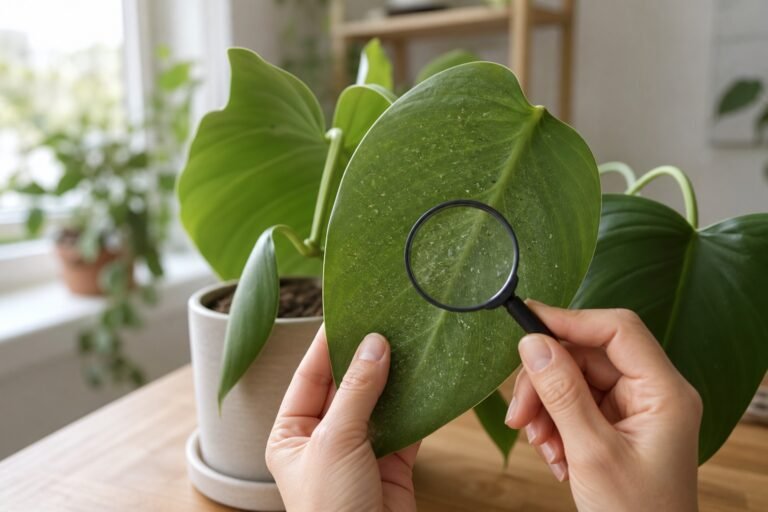
Do not spray because a pest appears on a list. Find the pest or a characteristic feeding pattern first. Isolate the plant while you inspect it, especially if the newest leaves are distorted.
Aphids, mealybugs, and scale
Aphids often cluster on tender new growth and can make young leaves curl or distort. Sticky honeydew, white cast skins, or ants add weight to that diagnosis. Mealybugs and soft scale also produce honeydew. Check leaf bases, petioles, stem joints, and the undersides of leaves.
For white cottony insects, use the mealybug routine. If you cannot find an insect, do not treat sticky residue as proof by itself. Sap, spilled drinks, and leaf products can confuse the picture.
Thrips
Thrips feed by scraping plant tissue. Look for irregular silver streaks or patches, distorted flowers or new leaves, and tiny dark drops of excrement. They are narrow and quick, so a hand lens and a white sheet of paper help. Tap a leaf over the paper and watch for moving slivers.
Spider mites and cyclamen mites
Spider mites leave fine stippling that can progress to yellowing, bronzing, and webbing. Webbing plus stippling is much stronger evidence than curl alone. The full inspection and control sequence is in the spider mite guide.
Cyclamen mites are much harder to see and often affect tender new growth on susceptible flowering plants. Severe distortion without visible aphids or thrips may need a diagnostic opinion rather than another general spray.
Fungus gnats are usually not the direct cause
Adult fungus gnats do not feed on leaves, so seeing small flies does not explain a curled leaf. University of Minnesota Extension describes their larvae as scavengers that feed mainly on fungi and decaying roots in damp media, and notes that they rarely damage indoor plants.
A heavy larval population can add root stress, especially around vulnerable young plants, but the more useful clue is often the wet potting mix that supports them. Treat the gnat problem and the moisture problem on their own evidence. The fungus gnat guide covers adults, larvae, and moisture control without presenting the flies as a universal leaf-curl cause.
Check 5: Look for salts, excess fertilizer, or chemical injury
Soluble salts accumulate from fertilizer and water. The clearest visual clue is a white to yellow crust on the media, pot rim, or drainage hole. Root tips can be injured as salts rise, leaving the plant wilted or scorched even when the mix contains moisture.
- Pause fertilizer while the plant is stressed.
- Check the product rate and whether more than one fertilizer source was used.
- If the container drains freely, leach from the top with clear water and empty the saucer.
- Repot when buildup is severe or roots are damaged.
More fertilizer is a poor response to an unexplained curl. Deficiencies and excess salts can overlap in appearance, and a true nutrient diagnosis may require testing. The houseplant fertilizer guide explains timing and dilution.
Also check for recent cleaners, oils, homemade soap, leaf shine, or pesticide sprays. Chemical injury often follows the application pattern. One side, one shelf, or the newest treated leaves may be affected. Rinse only when the product label or a qualified source supports it, and keep the container or ingredient list for diagnosis.
Check 6: Separate heat, cold, light, and humidity
These stresses overlap, but placement leaves clues.
- Heat: look for dry edges or scorch nearest a radiator, vent, hot window, or intense lamp.
- Cold: look for damage after contact with cold glass, a draft, or a sudden temperature drop. Symptoms can continue to develop after the exposure.
- Excess light: look for bleaching or scorch on exposed leaves, especially after a move.
- Low humidity: look for crisp margins on thin-leaved plants, but check root moisture and mites before blaming dry air.
Change placement gradually. Do not move a stressed shade plant straight into direct sun. If dry air is one part of the pattern, use the measured options in the humidity guide. For winter placement, check cold windows, vents, and seasonal watering.
Check 7: Know the disease and virus red flags
Curling alone is weak evidence for a virus. The concern rises when persistent distortion appears with light and dark green mosaic, mottling, ringspots, vein clearing, unusual color breaks, or stunting across new growth.
If that pattern appears, isolate the plant. Do not propagate it or share tools between it and healthy plants. Keep photos of the whole plant and close views of both leaf surfaces. A university plant diagnostic lab can tell you what sample it needs. Many viruses cannot be confirmed from appearance alone, and there is no general pesticide cure for an infected plant.
Root and crown diseases raise different flags: persistent wilt, rapid yellowing, soft or dark roots, stem collapse, lesions, or an unpleasant odor. Avoid treating those signs with more water. Iowa State University Extension notes that several pathogens can cause crown and root rot in wet or poorly drained media, but a lab or careful root examination is needed to separate disease from nonliving root injury.
Check 8: Change one thing and watch the next leaf
Once you have a likely cause, make the smallest useful correction. Water a genuinely dry root ball. Drain a wet cachepot. Move a plant away from a vent. Remove confirmed aphids. Pause fertilizer when salts are visible. Then hold the rest of the routine steady.
Old curled leaves may not flatten. Watch the next leaf and the rate of spread. Record the date, soil condition, treatment, and result. If new growth continues to distort or the plant declines, contact Extension or a plant diagnostic lab with that timeline.
A quick action router
- Only one old leaf is affected: monitor before treating.
- The root zone is truly dry: water thoroughly and correct the interval.
- The mix stays wet and the plant is declining: check drainage and roots.
- New growth has pest evidence: isolate, identify the pest, then use a labeled control.
- White crust and tip burn are present: address salts before adding fertilizer.
- The curl followed a move or repot: stabilize care and inspect only if symptoms progress.
- Mosaic, ringspots, stunting, or widespread distortion appear: isolate and seek diagnosis.
- No branch fits: stop adding treatments and ask a diagnostic lab.
Frequently asked questions
Should I cut off curling leaves?
Not automatically. Keep leaves that are mostly green because they still support the plant. Remove tissue that is dead, badly infested, or needed as a diagnostic sample only after you have photographed the pattern.
Will a curled leaf become flat again?
Sometimes a mildly thirsty leaf recovers. A leaf distorted while it was forming may keep that shape. Use new growth to judge whether the cause is fixed.
Do curling leaves always mean the plant is thirsty?
No. Dry roots are one possibility, but damaged roots in wet media can create a similar top-growth response. Check the root zone before watering.
Can fungus gnats make leaves curl?
The adults do not feed on leaves. Larvae live in moist media and usually feed on fungi and decaying material. Heavy populations may add root stress, but gnats are more often a sign that the pot stays wet than a direct explanation for curled foliage.
When should I throw the plant away?
Do not discard a plant for one curled leaf. Consider disposal when a confirmed virus, severe untreatable infestation, or advanced systemic disease puts the rest of the collection at risk. A diagnostic opinion is worth getting for a valuable or sentimental plant.
The short version
Leaf curl is a symptom bucket, not a single problem. Start with distribution and leaf age, then inspect moisture, roots, recent changes, pests, salts, and environmental stress. Reserve disease and virus conclusions for patterns with stronger evidence. One measured correction beats five guesses.
Sources and further reading
- University of California IPM: Houseplant Problems
- University of Minnesota Extension: Managing Insects on Indoor Plants
- University of Maryland Extension: Diagnose Indoor Plant Problems
- Virginia Cooperative Extension: Diagnosing Plant Problems
- Iowa State University Extension: Diagnosing Houseplant Problems from Diseases
- University of California IPM: Viruses and Viroid Diseases of Ornamentals
- University of Maryland Extension: Mineral and Fertilizer Salt Deposits on Indoor Plants
- Iowa State University Extension: How to Care for Houseplants