Powdery Mildew on Houseplants: 7 Safe Steps
Affiliate disclosure: As an Amazon Associate I earn from qualifying purchases. Links marked “paid link” may earn Fern & Shelf a commission at no extra cost to you. Read our full Affiliate Disclosure.
Last updated: August 12, 2026.
Start here: For a complete overview, see our Indoor Gardening for Absolute Beginners.
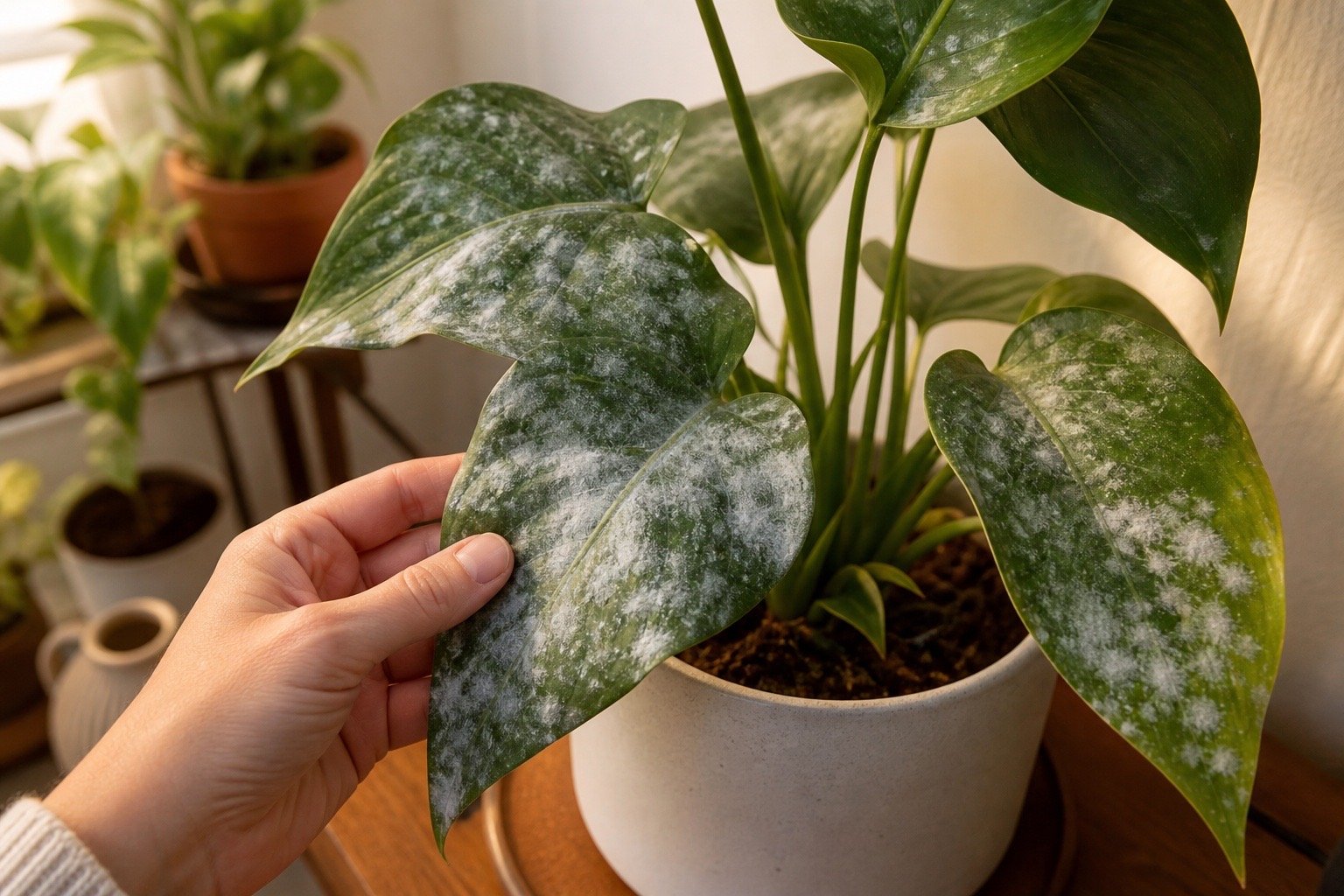
Powdery mildew on houseplants usually appears as white or gray powder across leaves, stems, or flower parts. It can look alarming, but it is not the same thing as fuzzy growth on potting soil, cottony insects in a leaf joint, or pale mineral residue left by water.
Start by working out what is on the plant. Then isolate it, remove badly affected tissue, improve the growing conditions, and decide whether a labeled fungicide is warranted. Guessing with pantry sprays can turn a manageable leaf disease into chemical scorch.
Powdery mildew on houseplants: 7 safe steps
Confirm the white material before treating
Powdery mildew fungi grow on the surface of susceptible plant tissue and produce the familiar dusty coating. The pattern may begin as small irregular patches and spread. Leaves can yellow, curl, brown, or drop when an infection becomes severe.
| What you see | More likely explanation | Best check |
|---|---|---|
| Flat white or gray dusty patches across leaf surfaces | Powdery mildew | Inspect several leaves in bright light and watch for new patches |
| Cottony tufts in leaf joints or along stems | Mealybugs | Look for individual insects and compare with the mealybug guide |
| Fuzzy growth only on the potting mix | Saprophytic surface fungi or another soil issue | Use the white mold on soil guide |
| Chalky rings or spots where droplets dried | Mineral residue | Wipe one area with plain water and review water quality |
| Webbing with fine pale stippling | Spider mites | Inspect leaf undersides and use the spider mite guide |
| Black, wet-looking, or sharply edged lesions | Bacterial or other fungal leaf spot | Avoid broad treatment and seek a diagnosis |
University of Maryland Extension says several fungi cause powdery mildew indoors, but the visible symptoms are similar. UC Statewide IPM notes that these fungi tend to be host specific. That means a powdery mildew affecting one plant may not infect every unrelated houseplant, though the same room conditions can favor disease on susceptible plants.
A hand lens can help separate a flat fungal coating from insects, shed skins, and webbing. When the pattern is unclear, photograph the whole plant and both sides of several leaves. A local Cooperative Extension office or diagnostic lab can offer more reliable identification than a generic image search.
Search Amazon for a 10x hand lens for plant inspection (paid link)
1. Move the plant away from the collection
Separate the affected plant while you investigate. Pick a position with suitable light and temperature, plus room around the foliage. Do not put it in a sealed dark cupboard; weak light and still air do not help recovery.
Check neighboring plants for fresh white patches. Clean fallen leaves from the shelf and avoid brushing infected foliage against healthy plants while moving it. The houseplant quarantine routine gives a practical setup for isolation and repeat inspections.
Wash your hands and clean tools after handling affected leaves. Do not reuse a cloth from the sick plant on the rest of the collection.
2. Remove the worst affected leaves
When only a few leaves are heavily coated, pruning them reduces the amount of fungal material in the room. Use clean sharp snips and cut at the leaf stem without tearing healthy tissue. Put the leaves directly into household trash.
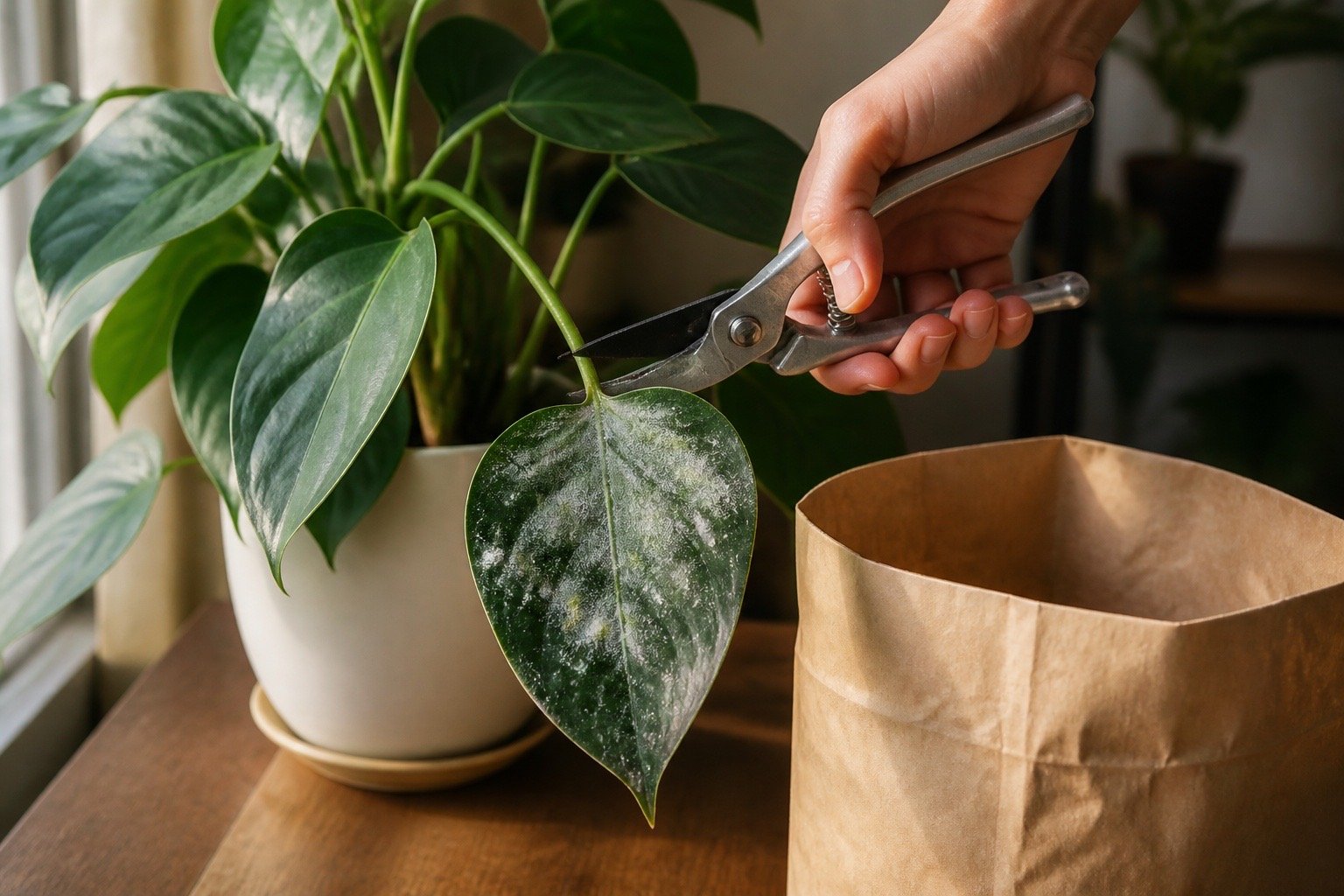
Do not strip a small or weak plant bare. It still needs leaf area to recover. If most of the canopy is affected, remove the worst sections and leave enough sound tissue for the plant to function.
Search Amazon for small bypass pruning snips (paid link)
Disinfect the cutting tool before using it elsewhere. Clean the shelf and remove dead plant material nearby. Powdery mildew is not a reason to pour disinfectant into the potting mix.
3. Give leaves space and gentle air movement
Crowded foliage creates sheltered pockets where humidity and temperature behave differently from the rest of the room. Move pots apart so leaves do not overlap. Thin only enough growth to open the plant without causing a second round of stress.
A small fan can improve circulation in a still room. Aim it past the plants on a low setting rather than blasting one pot until the leaves flutter constantly or the mix dries in a day. Cornell Greenhouse Horticulture includes spacing and airflow among the cultural tools used against powdery mildew.
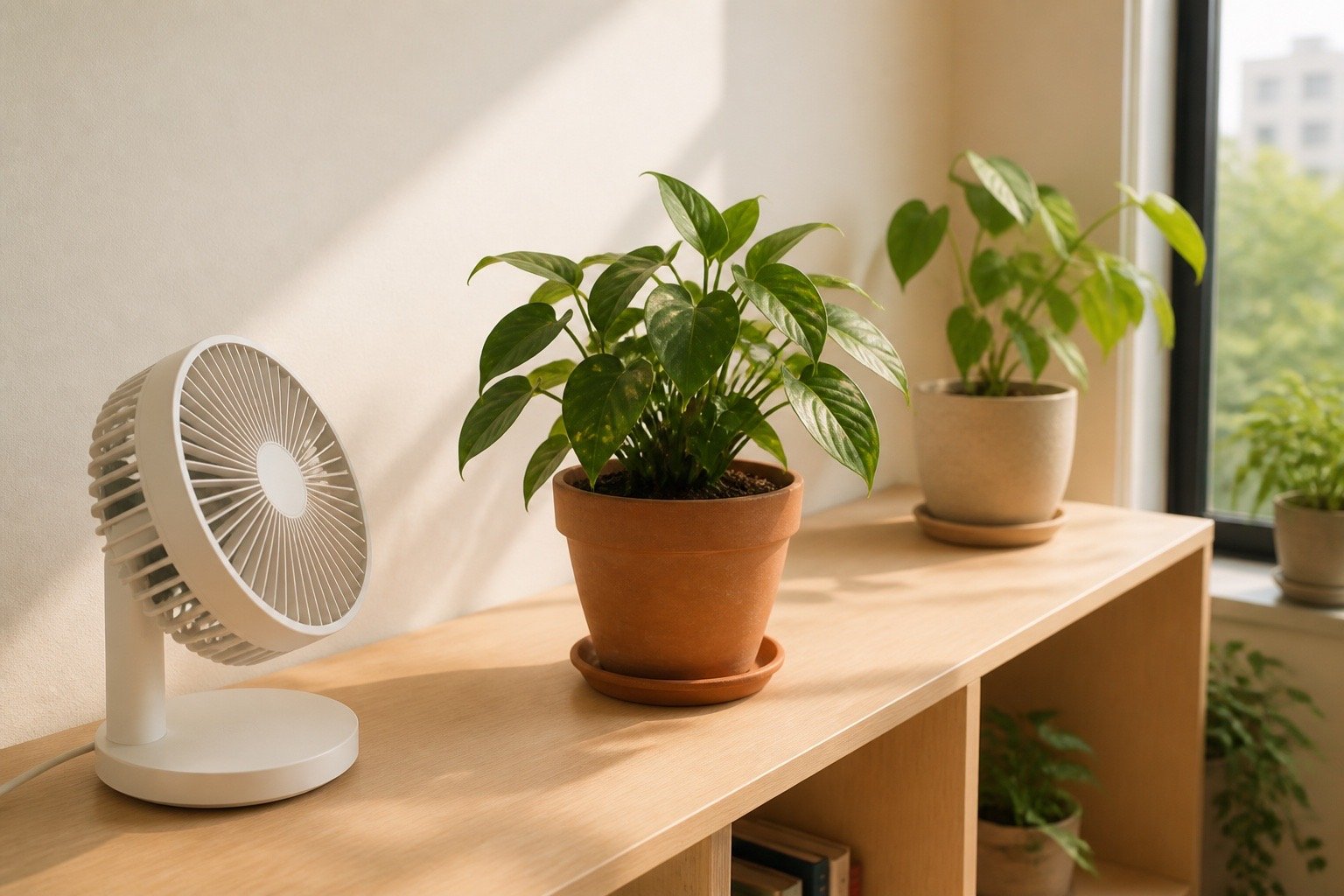
Search Amazon for a small quiet tabletop fan (paid link)
More air movement is not a substitute for proper light, watering, or diagnosis. It is one adjustment in a room where leaves have stayed crowded and still.
4. Correct water and light without shocking the plant
Water the root zone when the plant needs it and let excess drain. Avoid repeatedly wetting infected foliage late in the day. Although powdery mildew does not require standing water on a leaf to infect it, damp foliage and poor drying conditions can favor other diseases at the same time.
Check the pot rather than using a fixed watering day. The indoor plant watering guide explains how pot size, root volume, light, and season alter drying. If the mix remains wet for days, solve that issue instead of blaming every symptom on mildew.
Give the species the light it can tolerate. A shade-adapted plant can scorch if moved abruptly into direct sun, while a sun-loving plant kept too dark may grow weak. Gradual adjustment is safer. Use the houseplant problem diagnostic if several symptoms point in different directions.
5. Decide whether cultural care is enough
For a small indoor infection, removing affected tissue and improving spacing, light, and circulation may be sufficient. University of Maryland Extension says that under many home conditions, removing infected parts and correcting the environment can help without a fungicide.
Keep a simple record: the date you pruned, the leaves affected, and where new spots appear. Old damaged areas will not turn green again. Judge progress by whether clean new growth stays clean and whether the coating stops spreading.
If the disease continues, the plant is valuable, or the species is known to suffer badly, consult a local Extension specialist about diagnosis and legal treatment options. A photo cannot identify every white growth with certainty.
6. If needed, use only a correctly labeled fungicide
Identify the disease first. Read the current product label and confirm that it permits use on the plant or ornamental site, in the indoor setting where you plan to apply it, and against powdery mildew. Follow the listed rate, protective equipment, ventilation, coverage, reentry time, and repeat interval.
Test plant sensitivity on a small, inconspicuous section and wait as the label directs. Some oils, soaps, sulfur products, and other fungicides can injure sensitive foliage or react badly with another recent treatment. Never combine products unless the labels explicitly allow it.
Do not assume milk, baking soda, dish detergent, vinegar, essential oils, or another homemade mixture is universally safe. Research on one outdoor crop does not establish a safe rate for every indoor ornamental. Dish detergent is not a registered insecticidal soap or fungicide, and sodium buildup can damage plants.
The U.S. Environmental Protection Agency explains that the pesticide label defines how the product may legally be used. If the label does not fit your plant and location, choose a nonchemical approach or seek local advice rather than improvising.
Keep products in their original containers and away from children and pets. Never use an ornamental-only pesticide on an edible herb or crop.
7. Recheck the plant before ending isolation
Inspect the plant every few days at first, then continue at a sensible interval while it makes new growth. Look at both leaf surfaces, young stems, and neighboring pots. Remove fallen tissue promptly.
| Follow-up finding | What it suggests | Next move |
|---|---|---|
| No new patches and clean new leaves | Conditions and cleanup may be working | Continue monitoring before ending isolation |
| New powder appears on the same plant | Active disease remains | Recheck environment and follow any label interval exactly |
| White material appears only on soil | A separate root-zone or surface-fungus issue | Use the soil mold guide rather than repeating leaf treatment |
| Cottony clusters or moving insects appear | The original diagnosis may be wrong or incomplete | Stop fungicide use and identify the pest |
| Leaves scorch after a spray | Plant sensitivity, excess concentration, or poor application conditions | Stop treatment and follow label first-aid or plant-injury directions |
| Several unrelated plants show different spots | More than one problem may be present | Seek a diagnostic review instead of treating the room broadly |
There is no fixed quarantine finish date that suits every case. End isolation after repeated inspections show no active spread and healthy new growth remains clean. Keep the plant’s normal care needs in view during the process.
What causes powdery mildew indoors?
Powdery mildew is caused by fungi, but disease develops through an interaction between a susceptible host and favorable conditions. Crowded growth, poor air movement, weak light for the species, and stressed tissue can raise the odds of trouble. The exact preferences vary among powdery mildew fungi.
High room humidity is not the only possible explanation, and dropping humidity as low as possible can harm tropical foliage. Measure before changing the room. The guide to increasing humidity for houseplants also explains why misting creates only a brief local change and is not a dependable room-humidity control.
Seasonal changes matter. Plants near cold glass, heating vents, or short winter daylight may slow down and stay damp longer. Review the winter houseplant care guide before copying a summer watering routine into January.
Frequently asked questions
Is powdery mildew on houseplants dangerous to people?
Powdery mildew is a plant disease, not the same thing as household building mold. Still, avoid breathing dust or spray, wash your hands after handling affected foliage, and follow any pesticide label precautions. People with respiratory sensitivities should avoid doing cleanup in a closed room.
Will powdery mildew spread to every indoor plant?
Not necessarily. Powdery mildew fungi often have limited host ranges, but related susceptible plants may be at risk and similar room conditions can support separate infections. Isolate the affected pot and inspect its neighbors.
Can I wipe powdery mildew off the leaves?
Wiping may remove some surface growth from sturdy leaves, but it does not prove the infection is gone. Use a separate damp cloth, avoid rough handling, and discard or wash the cloth before it touches another plant. The leaf-cleaning guide covers safe handling for different leaf textures.
Should I repot a plant with powdery mildew?
Usually not for the leaf disease alone. Repotting adds root disturbance and does not remove a foliar infection. Repot only when the roots, container, or mix have their own problem.
Does neem oil cure powdery mildew?
Some registered horticultural oil products list powdery mildew on particular plants or ornamental sites. “Neem” on the front label is not enough. Confirm the complete current label, test sensitivity, respect temperature and timing restrictions, and do not combine it with incompatible products.
When should I discard the plant?
Disposal may be sensible when most foliage is affected, the plant is declining, treatment cannot be used safely, or a susceptible collection is at risk. Bag the plant before carrying it through the home.
Treat the disease you can identify
White material on a leaf invites a quick spray, but the better first move is a closer look. Powdery mildew, mealybugs, mineral residue, and soil fungi need different responses. Once the pattern fits mildew, remove the worst tissue and correct the conditions you can control.
Use a pesticide only when its current label fits the plant, disease, and indoor setting. Then monitor clean new growth. That quiet follow-up tells you far more than whether an old white patch wiped away.
Sources and further reading
Sources were checked August 12, 2026.
- University of Maryland Extension: Powdery Mildew on Indoor Plants
- UC Statewide IPM: Houseplant Problems
- Cornell Greenhouse Horticulture: Powdery Mildew
- UC Statewide IPM: Powdery Mildew on Ornamentals
- Wisconsin Horticulture: Powdery Mildew on Herbaceous Ornamentals
- Clemson Cooperative Extension: Powdery Mildew
- U.S. EPA: Introduction to Pesticide Labels