How to Propagate Succulents: 5 Reliable Methods
Affiliate disclosure: As an Amazon Associate I earn from qualifying purchases. Links marked “paid link” may earn Fern & Shelf a commission at no extra cost to you. Read our full Affiliate Disclosure.
Last updated: August 12, 2026.
Start here: For a complete overview, see our Indoor Gardening for Absolute Beginners.
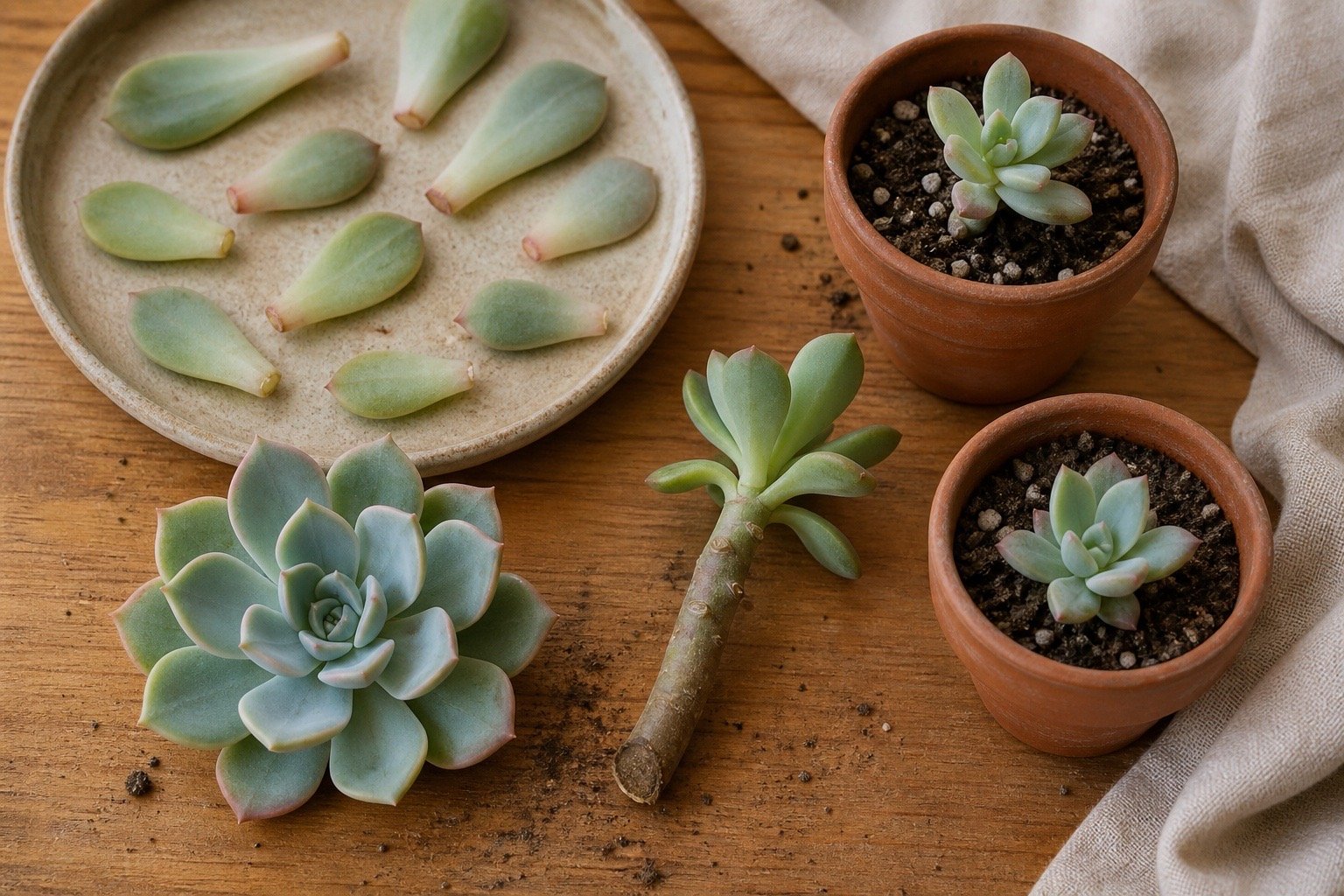
The first lesson in how to propagate succulents is that the plant chooses the method. A plump echeveria leaf may root and make a new rosette. An aloe leaf usually will not give the same dependable result, but an aloe offset with roots can. A clean cutting from a jade plant behaves differently from a handful of cactus seed.
So begin with a healthy parent and its botanical name. Choose the method that fits its growth habit, make a clean separation, and give the cutting enough light without keeping it wet. Most failed succulent propagation projects go wrong before roots appear: the wrong plant part was used, the leaf tore at the base, or the medium stayed soggy.
How to propagate succulents: match the method to the plant
| Method | Good starting candidates | What you need | Typical difficulty |
|---|---|---|---|
| Leaf cutting | Many Echeveria, Graptopetalum, Pachyphytum, and some Sedum | One complete healthy leaf | Easy when the species cooperates |
| Stem cutting | Jade, aeonium, sedum, many branching succulents | A healthy stem with a clean cut | Easy to moderate |
| Offset or pup | Aloe, haworthia, gasteria, sempervivum | A developed pup, ideally with roots | Often the most dependable |
| Division | Clumping plants with separate rooted crowns | A mature cluster with natural sections | Straightforward but more disruptive |
| Seed | Species that do not clone well, or when genetic variation is wanted | Fresh seed, sterile fine medium, patience | Slow and less predictable |
Iowa State University Extension stresses that the right method varies by succulent. Penn State Extension makes the same broader point for houseplants: stems, leaves, roots, division, and seeds are not interchangeable across species.
Before cutting anything, inspect the parent for pests, soft rot, and severe water stress. Propagating a sick plant can carry the original problem into every new pot. If the plant is newly purchased, use the houseplant quarantine guide before adding its cuttings to a shared propagation tray.
Set up a clean, low-fuss propagation station
You do not need a laboratory. You do need clean hands, a sharp blade for stem work, a dry tray for callusing, and a loose propagation medium. Wash used pots and disinfect cutting tools before moving from one plant to another.
Use a container with an open drainage hole. Tiny cuttings in an oversized pot sit beside a large mass of wet mix, so smaller is usually easier to manage. The indoor plant pot guide explains how drainage, size, and material change drying time.
For rooted cuttings and offsets, use a gritty mix suited to the plant rather than outdoor soil. Our succulent soil guide covers bagged mixes and a simple amendment approach. Penn State Extension recommends clean, well-aerated propagation media because garden soil can introduce pathogens and stay too dense.
Search Amazon for small precision pruning snips (paid link)
Search Amazon for gritty succulent potting mix (paid link)
Method 1: propagate from a complete leaf
Leaf propagation looks almost too simple, but the point where the leaf joins the stem decides a lot. Choose a firm, mature leaf with no translucent spots or pest damage. Hold it near the base and ease it away with a gentle sideways twist. The base should come away intact. A leaf snapped halfway up may form roots yet never make a new growing point.
Set the leaf on a clean, dry surface out of harsh sun so the wound can dry and seal. The callusing period varies with leaf size, temperature, and humidity. Do not force a fixed number of days onto every leaf; the cut end should look dry rather than wet or freshly torn.
Lay the callused leaf on top of dry or barely moist gritty medium. Do not bury it. Place the tray in bright indirect light. Strong midday sun can cook an unrooted leaf because it cannot replace water efficiently.
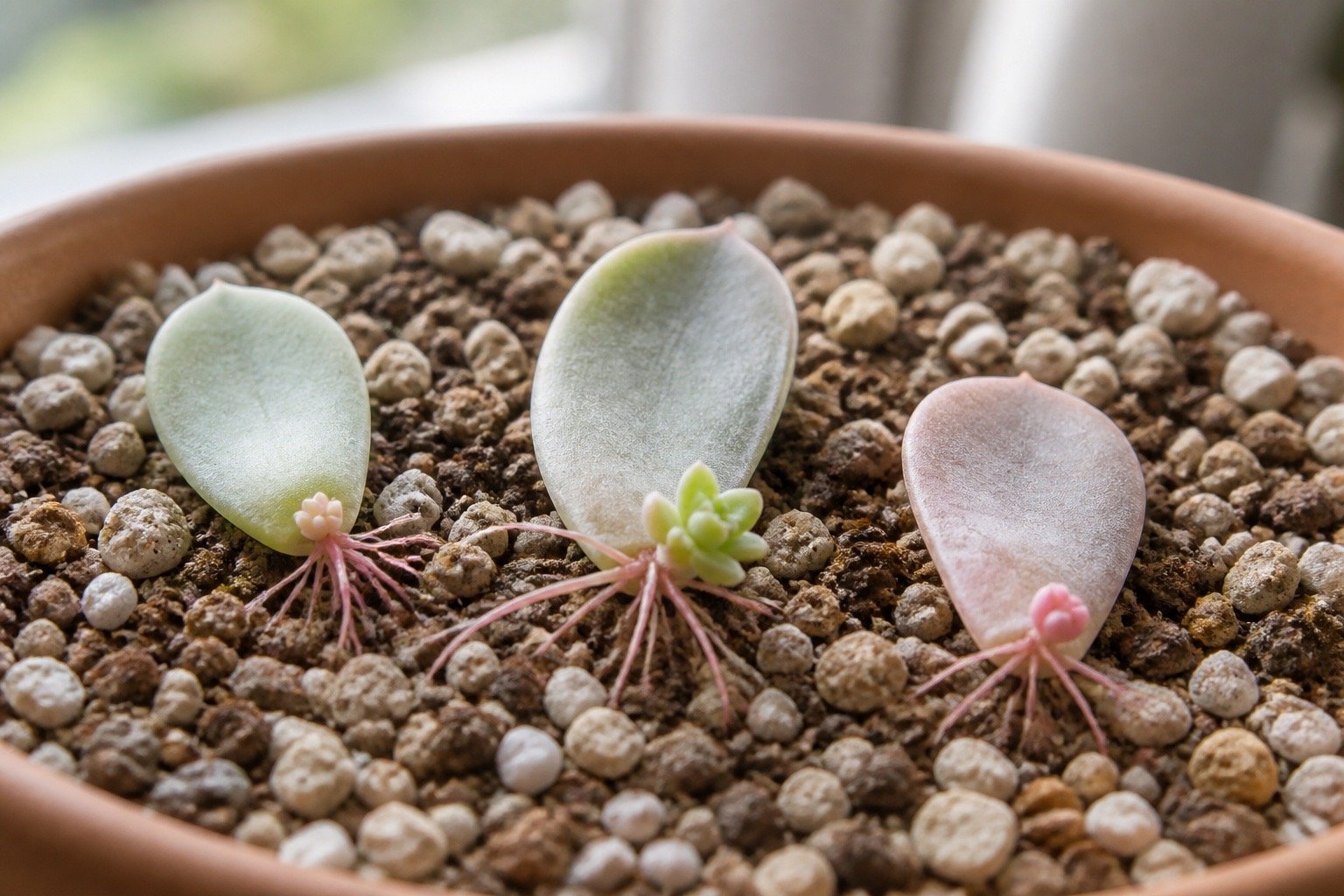
Wait for roots or a plantlet before adding small amounts of water near the roots. Constant misting keeps the old leaf wet and invites decay. Iowa State Extension advises slightly damp, well-drained rooting medium, while UC Agriculture and Natural Resources recommends allowing cut surfaces to callus before planting. The exact moisture balance depends on room conditions, so inspect the tray rather than following a daily spray habit.
Leave the original leaf attached while it remains firm enough to feed the plantlet. Once it dries naturally and the new plant has roots, move the young succulent to its own small pot.
Method 2: take a stem cutting
Stem cuttings suit branching succulents and plants that have become tall or bare below. Choose a healthy section with compact growth. Cut with a clean blade, then remove the lowest leaves so no foliage will sit beneath the medium.
Let the cut end callus in a dry, shaded place. Thicker stems need more time than thin ones. When the end is dry, insert it just deeply enough to stand in gritty mix. A stake can support a top-heavy cutting without burying extra stem.
Hold water at first, then water cautiously after the cut has sealed and the plant begins to anchor. Tugging to check for roots can tear the first fragile growth. Instead, look for steady resistance during normal handling and fresh leaves at the tip.
If you are correcting an elongated plant, read why succulents and other plants become leggy before putting the new cutting back in the same dim spot. A fresh cutting cannot fix inadequate light by itself. The guide to grow light distance can help if you use a lamp.
Method 3: separate an offset or pup
Offsets are small plants growing beside the parent. This is often the easiest route because a developed pup may already have roots and a complete growing point.
Slide the plant from its pot when the mix is dry enough to fall away without smearing. Trace the offset to its connection. If it separates with a gentle pull and carries roots, pot it directly into a small container. If it shares a tough stem, make one clean cut instead of twisting until tissue tears.
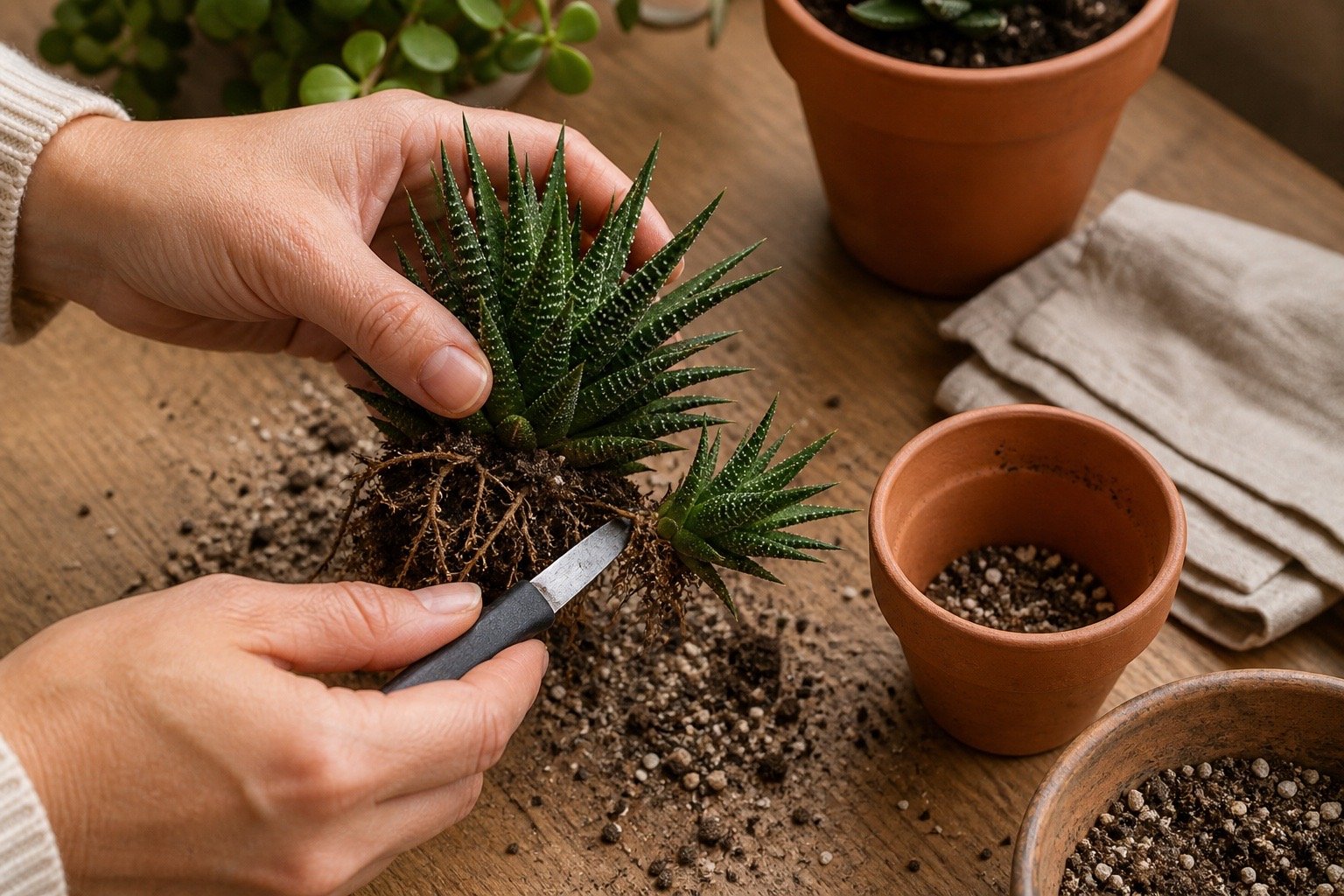
Allow a fresh cut to dry before potting. Set the pup at the same depth it grew before. Wait a short period before watering if roots or the connecting stem were cut, then resume careful moisture checks.
Search Amazon for small nursery pots with drainage (paid link)
Method 4: divide a rooted clump
Division works when a pot contains several rooted crowns rather than one plant with removable leaves. Haworthia and other clumping succulents may eventually form obvious sections.
Remove the whole cluster from its pot and loosen the mix so you can see where the roots belong. Pull apart sections that separate naturally. Cut only when a shared connection will not release cleanly. Each division needs healthy tissue and enough roots to support it.
Pot the divisions separately in containers that fit their root systems. This resembles repotting more than leaf propagation, so the houseplant repotting guide is useful for container sizing and aftercare. Do not divide a weak plant merely because it looks crowded. A stable clump is better than several struggling fragments.
Method 5: grow succulents from seed
Seed is slow, but it is the correct route for many cacti and for growers who want genetic variation rather than a clone. Buy seed identified by species from a reputable supplier. Dust-like seed needs a fine, clean starting medium and should usually remain near the surface; follow the packet because depth and temperature differ.
Moisten the medium evenly before sowing. A clear cover can reduce rapid drying during germination, but stagnant condensation raises disease risk. Provide bright filtered light, warmth appropriate to the species, and fresh air as seedlings emerge.
Do not expect seedlings to resemble mature plants quickly. Keep records and thin or transplant only when they are large enough to handle without crushing. Seed propagation rewards patience more than equipment.
Water, light, and feeding while roots form
Unrooted succulent pieces cannot use water like an established plant. A wet pot does not speed rooting; it narrows the margin before rot. On the other hand, fine new roots should not remain bone dry for long once they appear.
Use the cutting stage to decide what to do. Dry callusing material needs no watering. A leaf with new roots may need a small amount placed near the roots. A rooted offset can receive a more normal watering, followed by drainage and drying appropriate to that species. The broad indoor watering guide explains why pot size and root volume matter more than a weekly calendar.
Give bright indirect light during early rooting. Increase direct light gradually after the new plant is established. A sudden move from a propagation shelf to strong afternoon sun can scorch tender tissue.
Skip fertilizer until roots are established and growth resumes. Fresh propagation mix may already contain nutrients. Concentrated fertilizer around damaged or tiny roots adds risk without solving slow rooting.
Troubleshooting succulent propagation
| What you see | Likely reason | Next move |
|---|---|---|
| Leaf becomes translucent and mushy | Too much moisture, damaged leaf, or rot | Discard it and improve airflow and moisture control |
| Leaf grows roots but no plantlet | The leaf base was incomplete or the species is reluctant | Wait if the leaf is firm, but start another with an intact base |
| Stem cutting collapses at soil level | The cut was not sealed or the medium stayed wet | Remove rot, recut into healthy tissue, callus, and restart |
| Offset wrinkles after separation | Root loss, severe dryness, or hot light | Move to bright filtered light and check root condition |
| New rosette stretches | Insufficient usable light | Increase light gradually without scorching it |
| White crust forms on the mix | Mineral or fertilizer salt buildup | Stop feeding and review water quality and drainage |
| Nothing happens, but tissue stays firm | Cool conditions, species timing, or a slow method | Keep conditions stable and wait before changing everything |
The common temptation is to fix slow progress with more water. Resist it. If a cutting remains firm, clean, and free of rot, time may be the missing ingredient.
Frequently asked questions
How long does it take to propagate succulents?
There is no dependable universal timeline. Species, method, season, temperature, light, and the condition of the cutting all matter. Leaves may show roots before plantlets, while seeds can take much longer to become recognizable plants.
Can every succulent grow from one leaf?
No. Many echeverias and related plants can, but aloes, haworthias, and numerous other succulents are more dependable from offsets or division. Identify the plant before removing leaves.
Should succulent leaves be placed in water?
Some growers experiment with water, but the reliable beginner method for many leaf-propagated succulents is a complete callused leaf placed on a clean, airy medium. The existing water propagation guide covers houseplants that suit that method better.
Do succulent cuttings need rooting hormone?
Many common succulents root without it. Clean tissue, the right method, a callused wound, suitable light, and moisture control matter more. If you use a rooting product, follow its label and check that it suits the plant and propagation method.
When can I pot a propagated succulent?
Pot it when it has a functioning root system or when a rooted offset has been separated. Use a small draining pot and suitable mix. Leaf plantlets should remain with the original leaf until that leaf has naturally given up most of its stored moisture.
Why did my succulent cutting rot?
The wound may have stayed wet, the medium may have held too much water, or damaged tissue may have remained in the cutting. Cut back to firm healthy tissue, let the new cut dry, and restart in clean gritty mix.
Start with the part the plant already knows how to use
Successful succulent propagation is less about a clever trick than a good match. Use leaves for species that form plantlets from complete leaf bases. Use stems for branching plants. Choose rooted pups or division when the plant has already done half the work.
Then leave the cutting alone long enough to respond. Clean tools, modest moisture, and patient light checks do more than a shelf full of tonics. If the tissue stays firm and the wound stays clean, give it time.
Related guides and tools
Sources and further reading
Sources were checked August 12, 2026.
- Iowa State University Extension: How to Propagate Succulents
- Penn State Extension: Propagating Houseplants
- University of Missouri Extension: Home Propagation of Houseplants
- UC Agriculture and Natural Resources: Propagating Succulents
- NC State Extension: Plant Propagation by Leaf, Cane, and Root Cuttings
- University of Georgia Extension: Growing Indoor Plants With Success